The October extension deadline might feel like the end of a long tax season. Clients who filed for an extension are finally completing their 2025 returns, outstanding documents are being reconciled, and one more compliance deadline is being crossed off the list.
But from a planning perspective, Oct. 15 shouldn’t be the finish line. It should be the starting point.
For most individual taxpayers who requested a valid extension, Oct. 15, 2026, is the deadline to file the 2025 federal income tax return. The extension gave taxpayers more time to file, but not more time to pay. Any 2025 federal income tax that was due generally remained payable by April 15, 2026.
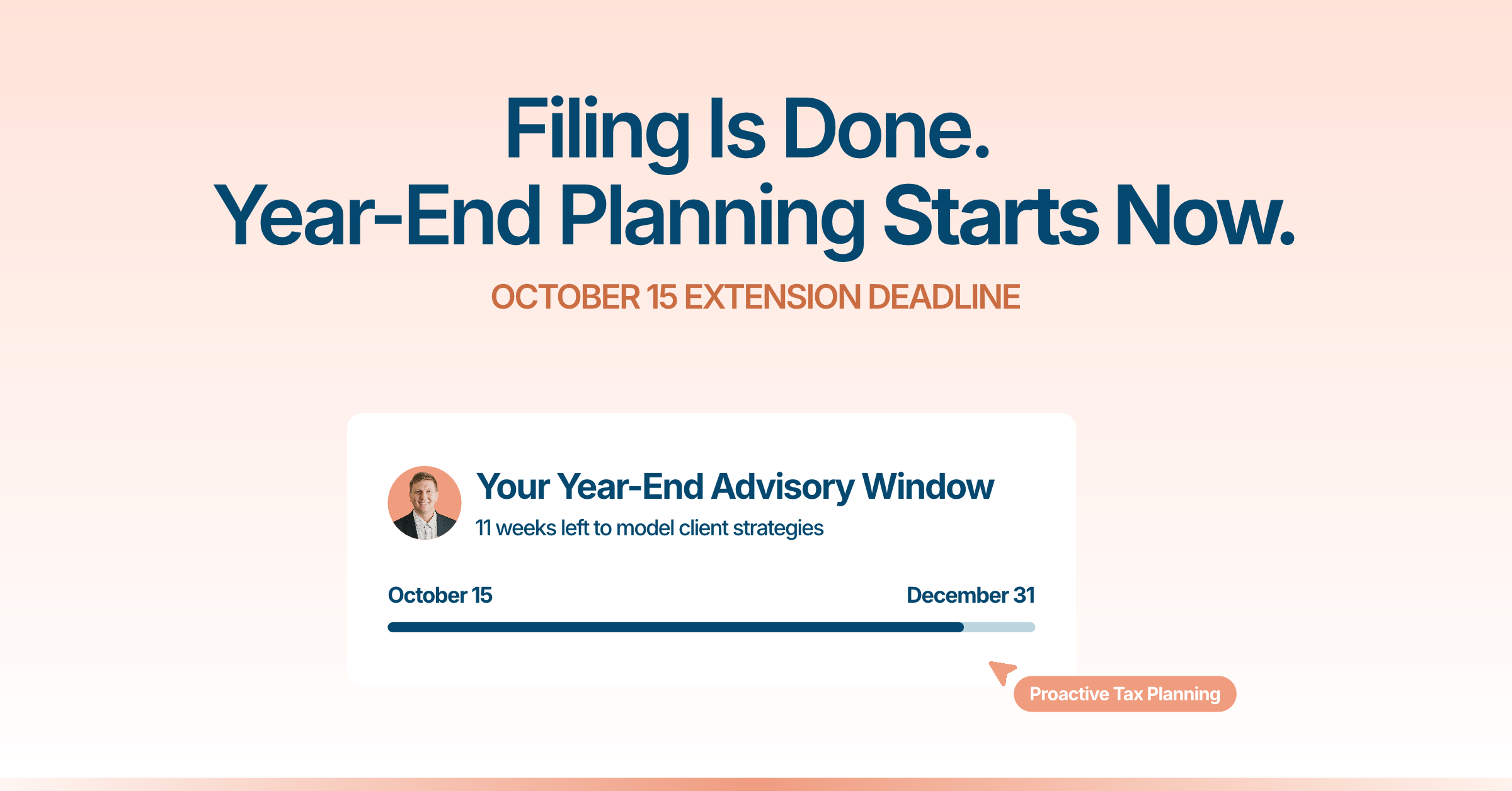
Once the return is complete, financial advisors have something valuable in hand: a detailed snapshot of the client’s financial life. And with roughly two and a half months left in the calendar year, there may still be time to use that information to make better decisions before 2026 ends.
🎯 The opportunity for financial advisors is simple: Don’t just file the return away. Analyze it, compare it with what’s happening now, and use it to start the year-end planning conversation.
The completed return is a planning document
A tax return tells you what happened last year, but its value goes well beyond documenting the past.
It can show where a client’s income came from, how investment activity affected taxes, whether retirement distributions created unexpected taxable income, how deductions and credits were used, and whether the client ended up owing significantly more—or receiving a much larger refund—than expected.
Those details can become prompts for broader conversations.
- Did the client realize a large capital gain?
- Did retirement distributions increase taxable income more than expected?
- Did a client with significant investment or self-employment income underpay throughout the year?
- Were charitable gifts large enough to suggest a more coordinated giving strategy?
- Are there loss carryforwards that could influence future portfolio decisions?
A return can reveal how different parts of the client’s financial life interact. That’s why the first conversation after an extension return is filed shouldn’t simply be, “Glad that’s done.” It should be, “What does this tell us about the rest of this year?”
Start by identifying what changed
A 2025 return gives you a baseline. The next step is to compare that baseline with the client’s 2026 reality.
Has the client retired? Changed jobs? Received a bonus, equity compensation, severance package, inheritance, or large distribution? Sold a business, home, investment property, or concentrated stock position? Started collecting Social Security? Increased charitable giving? Added consulting or self-employment income?
Even a straightforward return becomes more useful when paired with current-year information. For example, a client whose 2025 taxable income placed them comfortably within one tax bracket may be on track for materially different income in 2026. Another client may have unusually low income this year because of retirement, a sabbatical, a business slowdown, or the timing of a liquidity event.
The point isn’t to assume last year will repeat. It’s to use last year as the starting data set for asking better questions.
Review withholding and estimated payments before another surprise
One of the clearest planning opportunities after the Oct. 15 deadline is to look at how the client paid tax during 2025 and whether the same pattern is occurring in 2026.
A large balance due might indicate that withholding or estimated payments didn’t keep pace with income. A very large refund might indicate that the client had substantially more withheld than necessary.
The IRS describes federal income tax as a pay-as-you-go system and recommends checking withholding when income or major life circumstances change. Its Tax Withholding Estimator can help employees and retirees evaluate whether current withholding is likely to be sufficient.
Financial advisors can use the filed return, year-to-date income, and current withholding or estimated payment information to flag potential issues before the next filing season. For clients making estimated payments, the fourth payment for calendar-year 2026 is generally due Jan. 15, 2027.
🎖 The goal here is to make the client’s tax payments more intentional and reduce avoidable surprises, not just to minimize a refund or balance due.
Revisit investment gains and losses
A completed Schedule D can be particularly useful because it provides a clearer view of realized gains and losses, and potentially the client’s capital loss carryforwards.
If the client has realized significant gains in 2026, are there losses elsewhere in the portfolio that should be evaluated? If the client has capital loss carryforwards, could those affect the tax consequences of a planned sale? If the client has unusually low taxable income, does it make sense to model the impact of realizing gains intentionally?
Tax-loss harvesting shouldn’t drive the investment strategy by itself. Portfolio goals, holding periods, transaction costs, wash-sale rules, and the client’s broader financial plan all matter. But ignoring the tax information until the following spring can mean missing a planning window that closes at year-end.
Model retirement-income decisions while there’s still time
The period between Oct. 15 and Dec. 31 can also be important for retirement planning.
A completed return can show advisors how Social Security, pensions, IRA distributions, investment income, and other sources combined to produce the client’s taxable income. From there, advisors can model how additional income could change the picture.
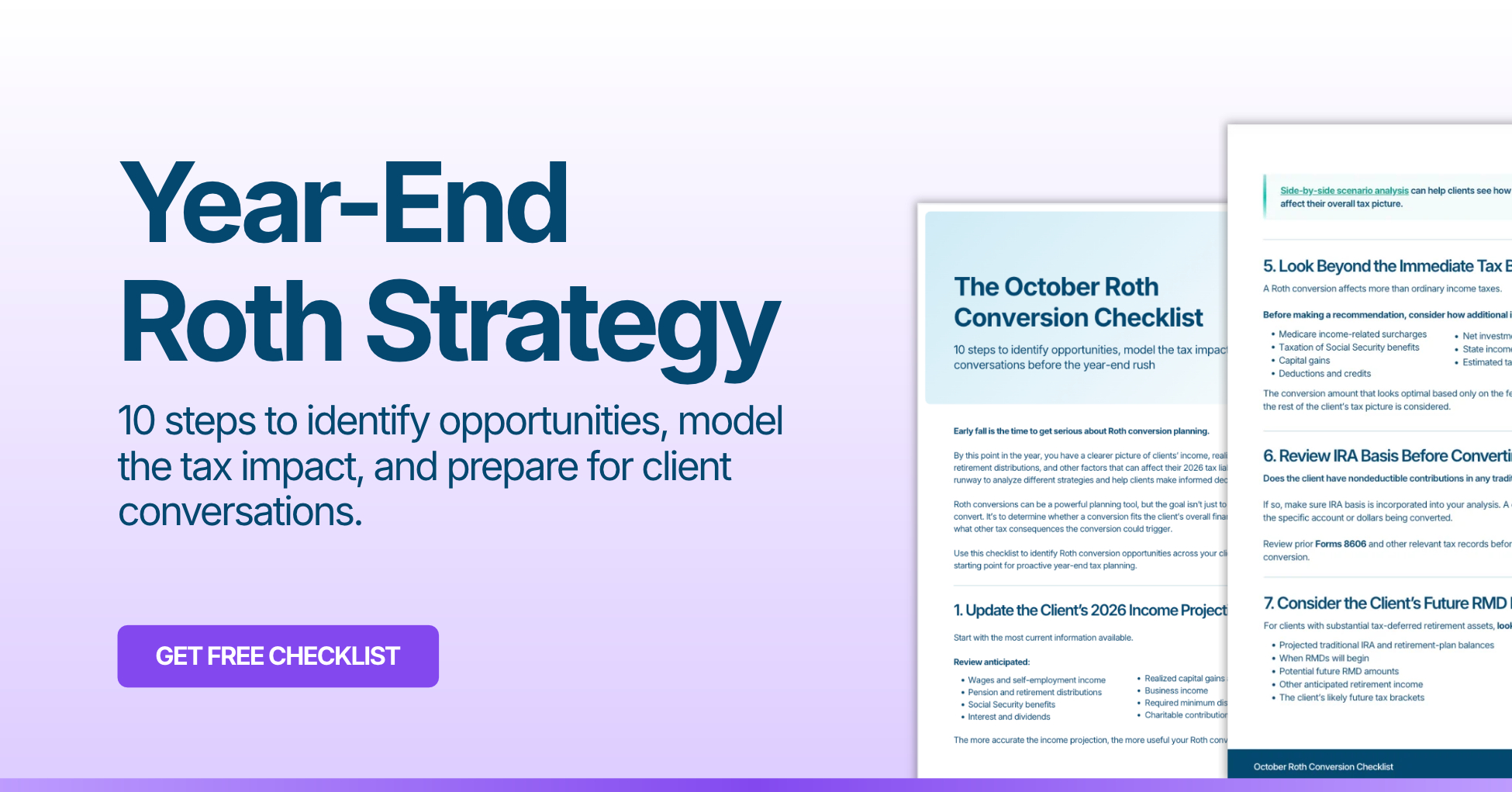
For some clients, that could mean evaluating a Roth conversion. The better question isn’t simply, “Should this client convert?” It’s, “How much could the client convert while staying aligned with the rest of the plan?”
That analysis may need to account for projected taxable income, capital gains, deductions, Medicare considerations, charitable giving, cash available to pay taxes, and long-term retirement goals. For other clients, the priority may be required minimum distributions. Advisors should confirm who is subject to an RMD, whether the correct amount has been taken, and what still needs to happen before the applicable deadline.
Coordinate charitable giving with the tax picture
Year-end charitable giving is another area where a tax return can provide useful context.
Instead of treating charitable gifts as a separate year-end task, advisors can look at them alongside income, capital gains, deductions, and portfolio holdings. A client who gives cash every December could benefit from evaluating appreciated securities. A client with a particularly high-income year might want to consider whether bunching gifts or using a donor-advised fund fits their goals. An eligible IRA owner who is charitably inclined might want to discuss qualified charitable distributions with the appropriate tax and financial professionals.
The planning question isn’t simply how much the client wants to give. It’s how to structure that giving in a way that supports both philanthropic goals and the broader financial plan.
Turn the filing conversation into a year-end planning meeting
One of the biggest risks of the extension deadline is letting the client disappear until January.
Instead, make the completed return a trigger for a short year-end planning process:
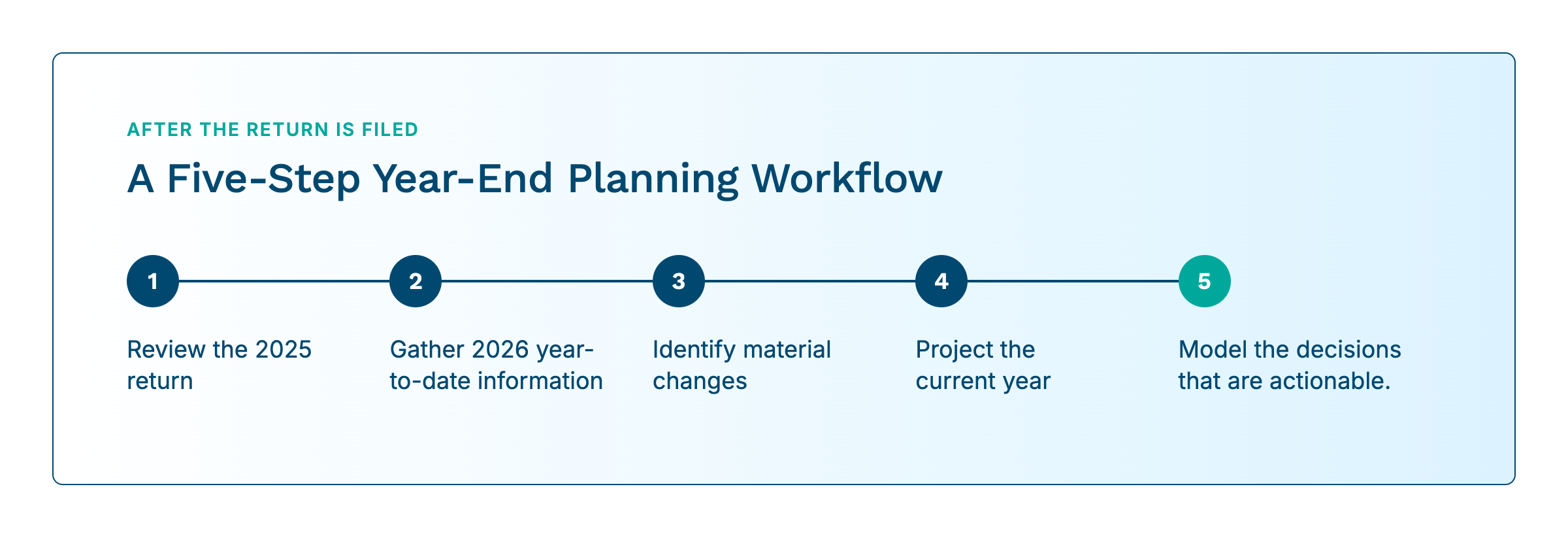
Depending on the client, that could include:
- Roth conversions or retirement distributions
- Capital gain or loss realization
- Charitable giving
- Withholding or estimated tax adjustments
- RMD planning
- Income-timing decisions
- Coordination with the client’s CPA or tax professional
Not every client needs every strategy. That’s exactly why analyzing the return matters: it helps advisors narrow the conversation to the opportunities that are actually relevant.
What Comes After Oct. 15? Holistiplan Can Help You Find Out
While the Oct. 15 deadline closes the book on a client’s 2025 tax filing, it also gives financial advisors fresh information they can use to make 2026 planning more proactive. Holistiplan helps turn that information into a repeatable planning workflow.
Advisors can analyze client tax returns and surface key data and potential planning opportunities without manually combing through page after page. From there, tools like Scenario Analysis can help model possible strategies and compare how different decisions may affect the client’s tax picture.
Instead of simply storing the completed return, Holistiplan empowers advisors to use it to identify clients who may benefit from a Roth conversion, capital-gains planning, charitable strategies, retirement-income decisions, or a closer look at withholding and estimated taxes. It also gives advisors a clearer framework for collaborating with a client’s CPA when tax-specific guidance or return preparation is needed.
But most of all, Holistiplan helps make tax planning easier to deliver consistently across a client base. The return becomes more than a compliance document—it becomes the starting point for a timely, personalized planning conversation.
⌛️ Oct. 15 is here. Don’t let the tax conversation end with the filing deadline.
Analyze the return. Identify what changed. Model the opportunities that are still available—and start planning for year-end with Holistiplan.
Book a Demo today