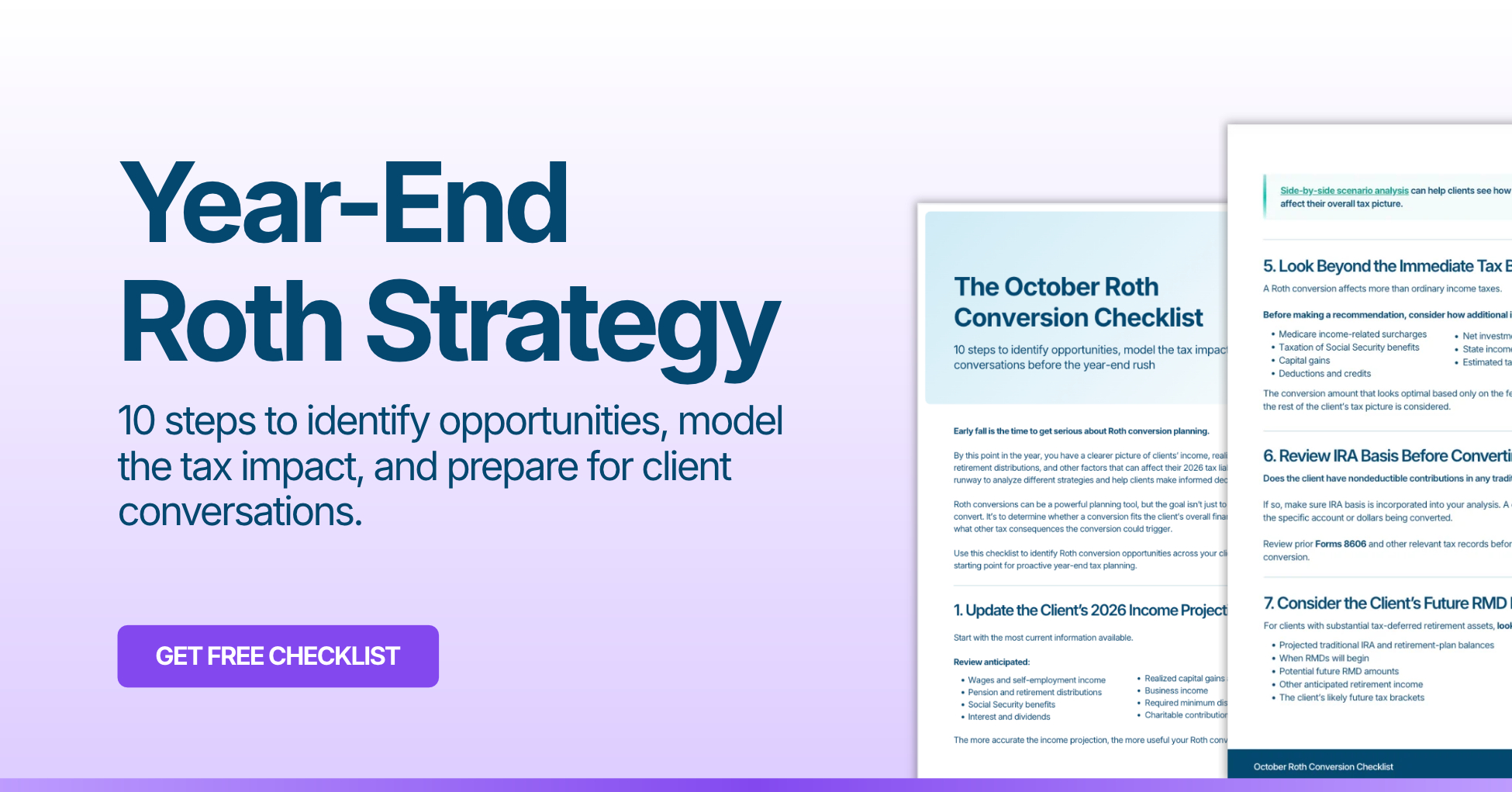
Fall is when Roth conversion planning starts to get more concrete.
By this time in the year, you usually have a better picture of a client’s income, realized capital gains, retirement distributions, deductions, and other factors that will shape the final tax picture. There’s also still enough time to compare different strategies before year-end decisions need to be made.
The question, though, isn’t simply whether a client should convert traditional IRA assets to Roth.
✍️ The more useful questions are: How much should they convert? What happens to the rest of their tax picture if they do? And how does that decision fit into the client’s longer-term plan?
Start with the client’s 2026 tax picture
Before modeling a conversion, start with the most current information available.
That includes wages, retirement distributions, Social Security benefits, investment income, capital gains and losses, business income, RMDs, charitable contributions, and other deductions. The more accurate the income projection, the more useful the Roth conversion analysis will be.
From there, look at where the client is likely to fall within the federal tax brackets and how much additional ordinary income they may be able to recognize before moving into a higher bracket. That available “room” can be a useful starting point for comparing potential conversion amounts.
Look for temporary low-income windows
Some clients may have an unusually attractive conversion opportunity because their taxable income is temporarily lower than normal.
That can include clients who recently retired, have not yet started RMDs, are delaying Social Security, experienced a temporary decline in business income, or have unusually large deductions.
Those windows can create an opportunity to recognize income intentionally rather than waiting until future distributions are required.
Compare more than one conversion amount
Roth conversion planning generally shouldn’t be treated as a yes-or-no decision.
Comparing several possibilities can give advisors and clients a much clearer picture of the trade-offs. That might mean looking at no conversion alongside several conversion amounts or modeling up to a particular tax-bracket threshold.
The goal is to see how each option changes the client’s overall tax picture, not simply identify the largest amount they can convert.
Don’t stop at the federal tax bracket
A conversion can affect much more than ordinary federal income taxes.
Additional income may interact with Medicare income-related surcharges, taxation of Social Security benefits, capital gains, deductions and credits, net investment income tax, state taxes, and estimated tax requirements.
That’s why the conversion amount that looks best based on the tax bracket alone may look very different once the rest of the client’s situation is taken into account.
Think beyond this year
For clients with significant tax-deferred retirement assets, Roth conversion planning can also be part of a longer-term strategy.
Future RMDs, anticipated retirement income, future tax brackets, and even the potential tax situation of a surviving spouse can all change the conversation.
The goal is not to push every client toward a Roth conversion. It’s to give clients enough information to understand the trade-offs and make a thoughtful decision while there is still time to act.
Get the full Roth Conversion checklist
There’s more to consider before moving forward, including IRA basis, how the client will pay the tax, future RMD exposure, and how to bring the conversation into year-end planning meetings.
💡Download The October Roth Conversion Checklist for Financial Advisors and Tax Pros for the full 10-step review.