The October 15 tax extension deadline has come and gone. You’ve gathered the documents, finalized the calculations, answered the last-minute questions, and helped your clients cross the filing finish line.
👀 Now what?
CPAs could just close the file, take a moment to catch your breath, and move on to the next deadline. But what if filing the return wasn’t the end of the client engagement? What if it was the beginning of a more valuable conversation?
A completed tax return is more than a record of what happened last year. It’s a starting point for identifying opportunities to improve a client’s tax situation going forward.
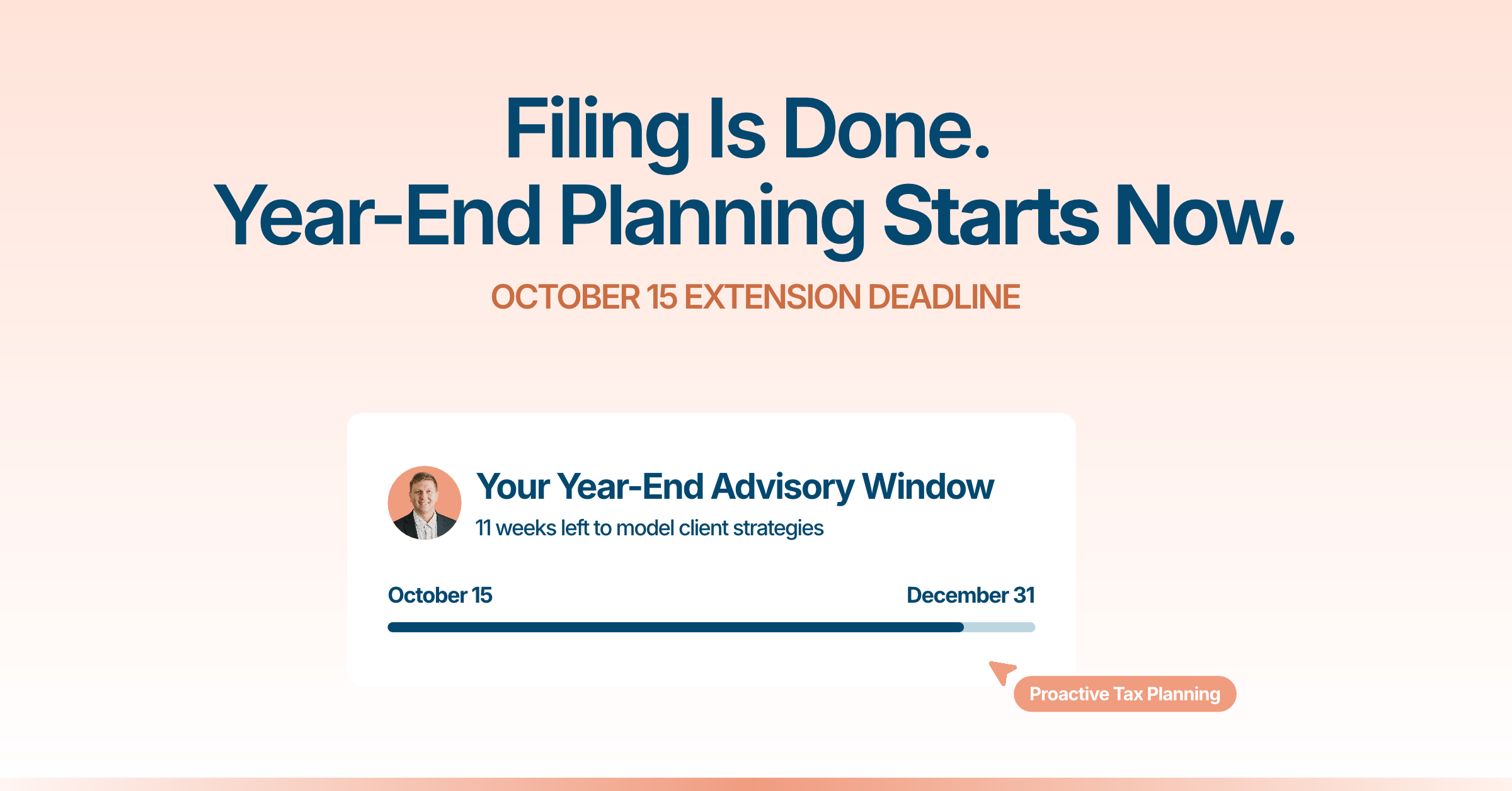
And with more than two months remaining in 2026, there’s still time to put some of those opportunities into action. The period immediately following October 15 presents an opportunity that’s too important to overlook for CPAs looking to expand their advisory services, deepen client relationships, and deliver more value beyond tax compliance.
Why the October 15 Tax Extension Deadline Shouldn’t End the Client Relationship
For most individual taxpayers who requested an extension, October 15, 2026, is the deadline to file their 2025 federal income tax returns.
But filing the return and planning for the future are two different things.
Tax preparation documents what happened. Tax planning helps clients make more informed decisions about what happens next.
Your clients may not recognize that distinction. From their perspective, once their return has been filed, their tax obligations are handled until next year. Unless you initiate another conversation, they might not realize there are additional opportunities worth exploring.
That’s where you come in.
You already understand their income, deductions, investments, business activities, and financial circumstances. You’ve reviewed their documents and identified the factors driving their tax liability.
Why wait until next filing season to put that knowledge to work?
Instead of ending your communication with a completed return and an invoice, consider following up with a simple question:
👉 “Now that we’ve finished your 2025 return, would you like to look at what we can do to improve your tax situation for 2026?” That question can turn a transactional engagement into an ongoing advisory relationship.
What Tax Planning Opportunities Can CPAs Find in a Completed 2025 Tax Return?
A completed 2025 tax return offers valuable information about a client’s financial situation. More importantly, it can highlight areas where proactive decisions could make a difference in 2026 and beyond.
Here are five opportunities worth exploring after the October 15 extension deadline.
1. Review Income Changes and 2026 Estimated Tax Payments
One of the first things to examine is how the client’s 2025 income compares with their expected income for 2026.
Did they receive a substantial bonus? Sell a business? Experience unusually high investment income? Report a large capital gain?
Or perhaps their circumstances have changed in the opposite direction. They may have retired, reduced their working hours, or experienced a decline in business revenue.
These changes can affect their tax bracket, estimated payment requirements, and overall tax planning strategy.
For clients with variable income, October is an especially useful time to revisit their 2026 tax projections.
Review withholding and estimated payments against projected liability, including applicable safe-harbor requirements. Determine whether adjustments are needed before year-end or whether the remaining estimated payment, generally due January 15, 2027, should be revised.
🎖The goal isn’t simply to prevent another surprising tax bill. It’s to help clients understand their tax obligations and make more informed financial decisions throughout the year.
2. Identify Capital Gains and Tax-Loss Harvesting Opportunities
A client’s 2025 Schedule D can tell you quite a bit about their investment activity.
Significant capital gains, realized losses, and capital loss carryforwards can all signal opportunities for additional planning.
For example, a client who realized substantial capital gains last year may be considering another major sale in 2026. Reviewing their current income and anticipated gains could help determine whether the timing of that transaction makes sense.
Likewise, clients with unrealized investment losses may benefit from evaluating tax-loss harvesting opportunities before December 31, taking wash-sale rules and the broader investment strategy into account.
The conversation doesn’t have to stop at investments, either. It can include real estate sales, concentrated stock positions, or other transactions that could create significant taxable gains.
By identifying these opportunities before year-end, you can help clients coordinate financial decisions with their tax strategy rather than address the consequences after the fact.
3. Evaluate Roth Conversion and Retirement Tax Planning Strategies
Retirement-related information on a client’s tax return can open the door to some of the most valuable long-term planning conversations.
Review IRA distributions, pension income, Social Security benefits, and other retirement-related activity.
Could a Roth conversion make sense? Is the client approaching required minimum distribution (RMD) age? Would changing the timing of retirement income improve their overall tax picture?
Consider a client who recently retired and expects substantially less taxable income in 2026 than in previous years. That temporary reduction could create an opportunity to evaluate a Roth conversion at a potentially favorable tax rate.
But the decision shouldn’t be based on marginal tax brackets alone.
You’ll also want to consider Medicare premium implications, Social Security taxation, other income-based thresholds, and the potential long-term impact of the conversion.
With the 2026 year-end approaching, now is an appropriate time to model these possibilities and help clients make decisions before applicable deadlines.
4. Revisit Charitable Giving and Business Tax Strategies
Charitable contributions and business income are two additional areas where a completed return can reveal missed or underutilized planning opportunities.
For charitably inclined clients, review their 2025 giving patterns and discuss whether their 2026 strategy still makes sense.
Depending on their circumstances, strategies worth evaluating may include:
- Qualified charitable distributions (QCDs)
- Donor-advised funds
- Contributions of appreciated assets
- Timing charitable gifts to maximize available tax benefits
For business-owner clients, review business income, deductions, depreciation, and qualified business income considerations.
A business that experienced significant growth or a decline in revenue may need an updated projection. Changes in compensation, equipment purchases, or retirement plan contributions could also present planning opportunities.
🔑 The key is to make sure tax decisions align with the client’s current circumstances and the rules applicable to 2026, rather than simply repeating what worked in 2025.
5. Look for Life Changes That Could Affect Future Tax Returns
Not every planning opportunity appears as an obvious number on a return.
Sometimes the most valuable insights come from understanding what’s changed in a client’s life.
A marriage, divorce, new child, retirement, inheritance, home sale, or business transition could significantly affect their tax situation.
Even seemingly small changes may have implications for filing status, credits, deductions, withholding, and future income.
Use the completed return as a reason to ask what has changed since the end of 2025—and what changes the client expects in 2027.
Why Year-End 2026 Tax Planning Matters After October 15
The challenge with October tax planning is that the calendar is already working against you.
By the time extended returns are filed, much of the current tax year has passed. Some planning opportunities are no longer available, while others require action before December 31.
That’s why prioritization matters.
Start with clients whose returns reveal potential planning opportunities that are both meaningful and time-sensitive.
A retiree considering a Roth conversion, for example, may need to complete the transaction before year-end. A business owner anticipating a significant income change may benefit from reviewing projected taxes and available deductions. An investor with substantial gains may need time to coordinate tax-loss harvesting with their financial advisor.
🚨Not every client needs an extensive tax planning engagement immediately. But every completed return deserves a look at whether there’s something worth discussing before the year ends.
The earlier you initiate that conversation, the more options your clients may have.
How CPAs Can Turn Post-Filing Tax Reviews Into Year-Round Advisory Services
Identifying tax planning opportunities is important. Turning those opportunities into a consistent service is what creates long-term value.
And that doesn’t necessarily require dramatically changing how your firm operates.
Start by building a repeatable post-filing workflow around three steps.
Step 1: Review the Return for Planning Opportunities
Before closing a client’s file, examine the return through a forward-looking lens.
Identify changes in income, significant gains or losses, retirement-related activity, business deductions, and other items that could warrant additional analysis.
You don’t need to develop a complete plan for every client at this stage. The objective is to determine which clients could benefit from a deeper conversation.
Step 2: Follow Up With Specific, Relevant Insights
Generic messages about year-end tax planning are easy to ignore.
Personalized outreach is more compelling.
Instead of saying, “Contact us if you need tax planning,” try something like:
“While reviewing your return, I noticed a few areas that could affect your 2026 taxes. I’d like to walk through those with you before year-end.”
You’re giving the client a specific reason to reconnect—and demonstrating that you’re thinking beyond compliance.
Step 3: Offer an Ongoing Tax Planning Engagement
Once clients understand the potential value, explain how a proactive planning relationship works.
That might involve periodic tax projections, midyear reviews, year-end planning meetings, or coordinated discussions with their financial advisors.
Define the scope, deliverables, and pricing so clients understand the distinction between tax preparation and advisory services.
For your firm, this creates an opportunity to generate recurring advisory revenue, strengthen client retention, and build relationships that extend beyond filing season.
For clients, it means having someone actively helping them anticipate tax consequences rather than simply reporting them after the fact.
How Holistiplan Helps CPAs Turn Extended Tax Returns Into Proactive Tax Planning
Moving from compliance to advisory services sounds appealing. But time is often a major hurdle.
After months of preparing returns and managing deadlines, finding the capacity to manually analyze every client’s tax planning opportunities can feel overwhelming.
That’s where Holistiplan can help.
Holistiplan helps CPAs turn completed tax returns into actionable tax planning insights without relying on time-consuming manual analysis.

That means you can spend less time gathering and organizing tax information and more time delivering the expertise your clients value.
October 15 doesn’t have to mark the end of your client engagement. It can mark the beginning of a more proactive, profitable, and enduring relationship.
🏆 Don’t just file the return and move on. Move from filing the return to planning what comes next, with Holistiplan.