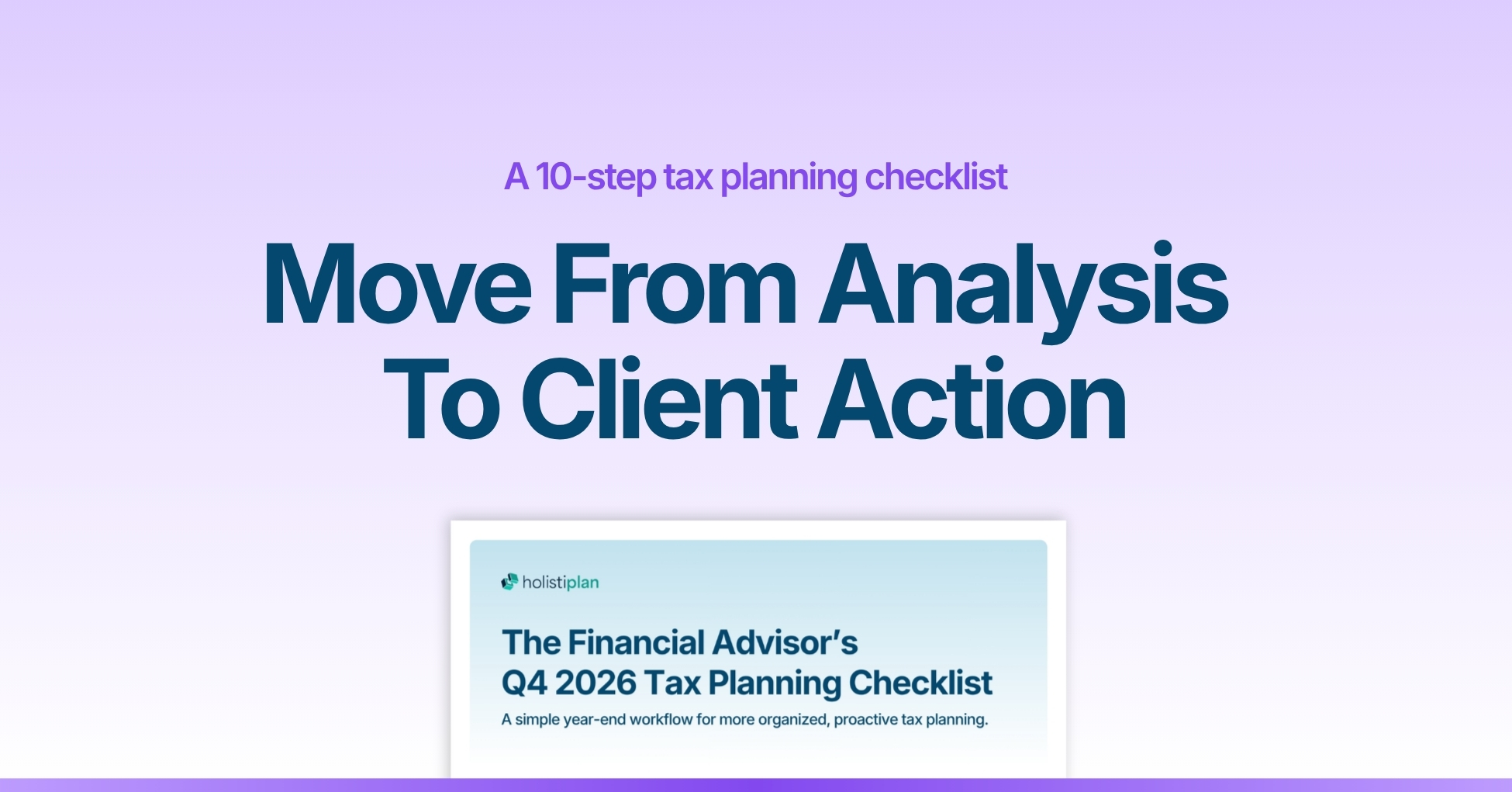
📌 Free Download: Don’t let year-end planning slip through the cracks. Download the Financial Advisor’s Q4 2026 Tax Planning Checklist and standardize your client workflow from review to execution
Some of financial advisors’ most valuable client conversations of the years take place during Q4. But those last three months frequently become the busiest on the calendar.
By October, the window for implementing many tax strategies is narrowing. Clients are juggling work, travel, holidays, and their own year-end obligations. Advisory teams are trying to gather updated information, analyze opportunities, communicate recommendations, coordinate with tax professionals, and make sure everything actually gets done before applicable deadlines.
The firms that handle Q4 tax planning effectively tend to have one thing in common: a repeatable process that moves from information gathering to analysis to action. A standardized approach can help advisors review more households consistently, uncover opportunities clients may not know to ask about, and spend more time discussing strategy instead of chasing documents.
As Q4 2026 gets underway, use this checklist to keep clients—and your firm—on track.
1. Make Sure You Have a Current Tax Return for Every Client
⏳ Start with the foundation: last year’s tax return.
The return gives you a baseline for understanding what actually happened in the client’s financial life. It can refresh your knowledge of previous planning conversations while revealing carryforwards, losses, income sources, deductions, distributions, and other details that could influence this year’s strategy.
And don’t limit tax-return reviews to clients you consider “complex.” A seemingly straightforward client may have opportunities that have never come up in conversation. Their financial situation also may have gradually changed through a promotion, inheritance, investment activity, retirement, charitable giving, or other events.
Identify any clients whose most recent returns are still missing and request them immediately. Then establish a consistent process for reviewing every return rather than relying solely on an individual advisor’s memory or instincts.
2. Bring the Client’s 2026 Tax Picture Up to Date
A 2025 tax return tells you where the client has been. Effective Q4 planning requires knowing where the client is now. So, gather current-year information and ask what’s changed.
Has the client received a raise or bonus? Changed jobs? Increased retirement contributions? Made a significant charitable gift? Opened or closed outside accounts? Realized a large capital gain? Retired? Started a business? Experienced another major financial event?
For W-2 employees, a recent paystub can be particularly useful because it provides a snapshot of wages, withholding, retirement contributions, insurance deductions, and other year-to-date information.
The goal here isn’t just to collect more data. It’s to create an accurate enough picture of the client’s 2026 situation to model potential decisions while there’s still time to make them.
Request updated income, withholding, investment, retirement, and other relevant information from clients as early as possible.
3. Identify Tax Planning Opportunities That Matter Most
Once you understand where the client stands, shift from reporting to planning.
A standardized review process is useful here because it helps ensure every household receives a baseline level of analysis. But consistency doesn’t mean making identical recommendations to every client. It means putting every client through a reliable process to determine which issues actually matter to them.
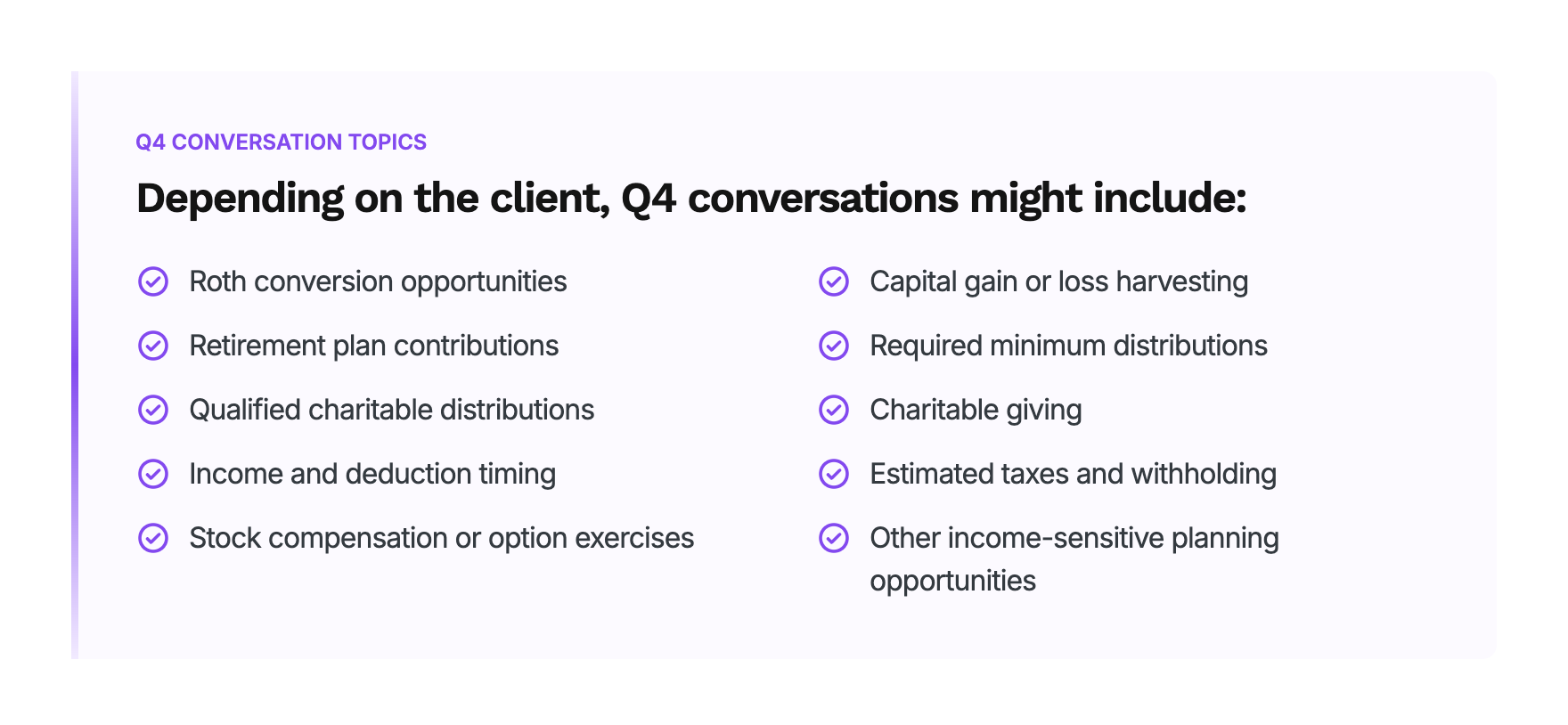
Don’t make the mistake of treating every finding as equally important. A tax analysis may uncover several technically valid observations, but that doesn’t mean the client needs ten recommendations.
Your value as an advisor comes in part from helping clients understand which decisions matter most. Narrow the analysis to the highest-impact opportunities and prioritize the decisions that need to be made before year-end.
4. Model Scenarios Before Making Recommendations
Identifying an opportunity is just the beginning.
Suppose a client appears to be a candidate for a Roth conversion. The important question isn’t simply whether they should convert. It’s how different conversion amounts could affect their broader tax picture.
The same principle applies elsewhere.
What happens if the client realizes additional capital gains? Accelerates charitable giving? Changes retirement contributions? Receives a larger-than-expected bonus?
Scenario modeling empowers advisors to move the conversation from, “Here’s something you should consider” to, “Here’s what could happen under these different approaches.” It’s a big distinction, and one that can make tax planning much more tangible for clients.
It can also improve collaboration with the client’s CPA or other tax professional because the conversation can center on a specific proposed strategy and its estimated effects rather than a vague planning idea.
Model relevant alternatives before the client meeting so you can clearly illustrate potential trade-offs and identify questions that require additional tax-professional input.
5. Review Retirement and Distribution Decisions
Q4 is an important time to review retirement-related tax decisions.
Confirm whether applicable required minimum distributions have been or will be completed. Review retirement plan contributions and whether clients have room to increase contributions before year-end. Consider whether charitable clients may benefit from qualified charitable distributions where appropriate.
For clients considering Roth conversions, pay close attention to timing. Because conversions generally need to occur during the calendar year to count for that tax year, waiting until the final days of December can create unnecessary execution risk.
These decisions shouldn’t be evaluated independently. A Roth conversion, for example, could affect taxable income and other income-sensitive areas of the client’s financial plan.
Review retirement accounts now and identify transactions that require action before December 31.
6. Review Capital Gains, Losses, and Charitable Giving Together
Investment and charitable planning can intersect in valuable ways.
Review year-to-date realized gains and losses along with unrealized positions. Some clients may have opportunities to harvest losses to offset gains, while others may benefit from intentionally realizing gains as part of a broader portfolio or tax strategy.
Then consider charitable intentions. For clients who already plan to give, donating appreciated securities or using other charitable strategies might warrant analysis. The important thing is to avoid viewing investments, taxes, and charitable goals as three separate conversations.
Review the client’s taxable portfolio alongside their projected income and charitable plans before executing year-end transactions.
7. Check Withholding and Estimated Tax Payments
🚨 Tax planning isn’t complete if the client receives an unexpected tax bill that could’ve been anticipated.
Compare projected tax liability with year-to-date withholding and estimated payments. Pay particular attention to clients who experienced significant changes during 2026, such as bonuses, investment gains, business income, property sales, retirement distributions, or other unusual income. Then determine whether adjustments are necessary and coordinate with the client’s tax professional where appropriate.
Make payment planning part of the year-end review instead of waiting for tax preparation season to discover a shortfall.
8. Give Every Task a Clear Owner
The best tax strategy is useless if no one implements it.
For advisory firms, this means answering practical questions such as:
- Who reviews the return?
- Who gathers current-year information?
- Who prepares the analysis?
- Who communicates with the client?
- Who coordinates with the CPA?
- Who executes the transaction?
- Who confirms it was completed?
As firms expand tax planning services, keeping the entire workflow inside the lead advisor’s head becomes increasingly difficult to scale. Explicit ownership and clearly defined communication reduce informal handoffs, memory-dependent processes, and last-minute status checks. Assign an owner and deadline to every outstanding planning task.
9. Turn Every Client Meeting Into an Action Plan
Finding a planning opportunity isn’t the same thing as implementing one.
This is where even strong tax-planning processes can break down. An advisor can conduct excellent analysis and have a productive meeting, only for the client to walk away with several ideas and no clear understanding of what happens next.
Every year-end planning meeting should conclude by answering a few basic questions:
- What decision was made?
- What does the client need to do?
- What does the advisor or another professional need to do?
- Who owns each task?
- What is the deadline?
- When will the firm follow up?
The measure of a successful Q4 shouldn’t simply be how many tax reports your firm completed. What matters is whether important decisions were made and agreed-upon actions were implemented. Finish every meeting with documented next steps, owners, deadlines, and follow-up dates.
10. Coordinate With the Client’s Tax Professional Before Year-End
Financial advisors don’t need to become tax experts to make tax planning a meaningful part of the client relationship. Instead, use Q4 to strengthen collaboration with CPAs and other tax professionals.
When a strategy requires their input, give them something concrete to evaluate: the client’s updated information, the proposed strategy, the assumptions used, and the modeled outcome. The earlier that coordination happens, the more time everyone has to resolve questions and implement the final decision.
✍️ Identify recommendations requiring tax-professional review and begin that collaboration well before the final days of December.
Make Q4 Tax Planning More Scalable With Holistiplan
The biggest challenge with Q4 tax planning isn’t a lack of potential strategies. It’s executing the process consistently across an entire client base.
Holistiplan makes a difference here.
Instead of spending Q4 manually gathering information, reviewing returns one by one, building analyses from scratch, and trying to keep track of every household’s status, Holistiplan allows financial advisors to create a more systematic tax planning workflow. Client upload links, direct email requests, bulk outreach, and Tax Return Staging can help firms collect returns and see which households are still missing documents.
Once the information is collected, Holistiplan helps advisors move from historical tax reporting to forward-looking planning. Advisors can upload current paystubs into the Scenario Analysis feature to incorporate updated client information and compare potential paths forward. That makes it easier to work through many of the decisions on this Q4 checklist, from understanding a client’s current tax picture and spotting planning opportunities to modeling scenarios and preparing for more productive client conversations.
Holistiplan can also support a team-based process. Firms can give team members their own access so responsibilities such as document collection, workflow updates, and follow-up don’t all have to live with the lead advisor.
Holstiplan doesn’t just help firms make their year-end tax planning faster. It helps transform tax planning from a reactive year-end exercise into a repeatable, scalable process for demonstrating proactive value. And that’s the opportunity for financial advisors in Q4 2026: review every client, identify the opportunities that matter, model the potential outcomes, turn recommendations into action, and build a process you can repeat next year.
Ready to make year-end tax planning more efficient and scalable? See how Holistiplan can help your firm move from tax return to planning opportunity, and from analysis to action.
Make the most of Q4 with Holistiplan.
Book a demo today