Roth conversions can be one of the most powerful tools for helping clients reduce their lifetime tax burden. But knowing when to convert, how much to convert, and whether a conversion actually makes financial sense isn’t always straightforward.
A Roth conversion that looks attractive today could create unintended tax consequences tomorrow. Converting too much could push a client into a higher tax bracket or trigger Medicare income-related monthly adjustment amounts (IRMAA). Converting too little could mean missing an opportunity to reduce future required minimum distributions (RMDs) and preserve more wealth for retirement or heirs.
That’s why Roth conversion planning needs to extend beyond a single tax year.
Holistiplan’s Roth Projection Tool helps financial advisors evaluate how conversions may affect a client’s financial picture over their lifetime. By modeling income, assets, spending, taxes, Medicare costs, and estate considerations, advisors can explore different strategies and demonstrate their potential long-term value.
Let’s walk through three practical use cases that show how the Roth Projection Tool can help advisors move from identifying conversion opportunities to implementing more informed, tax-efficient strategies.
USE CASE #1
Build a Multi-Year Roth Conversion Strategy to Reduce Lifetime Taxes
One of the biggest challenges in Roth conversion planning is determining how much a client should convert each year. Rather than making that decision in isolation, advisors need to understand how a series of conversions could affect the client’s lifetime tax liability.
Holistiplan’s Roth Projection Tool helps advisors build that long-term picture.
Meet Bob and Jane: A Retirement Planning Scenario
Consider Bob and Jane Roth, a hypothetical married couple filing jointly. Bob is 62 and Jane is 60. Bob plans to retire in two years, while Jane is already retired and collecting a pension.
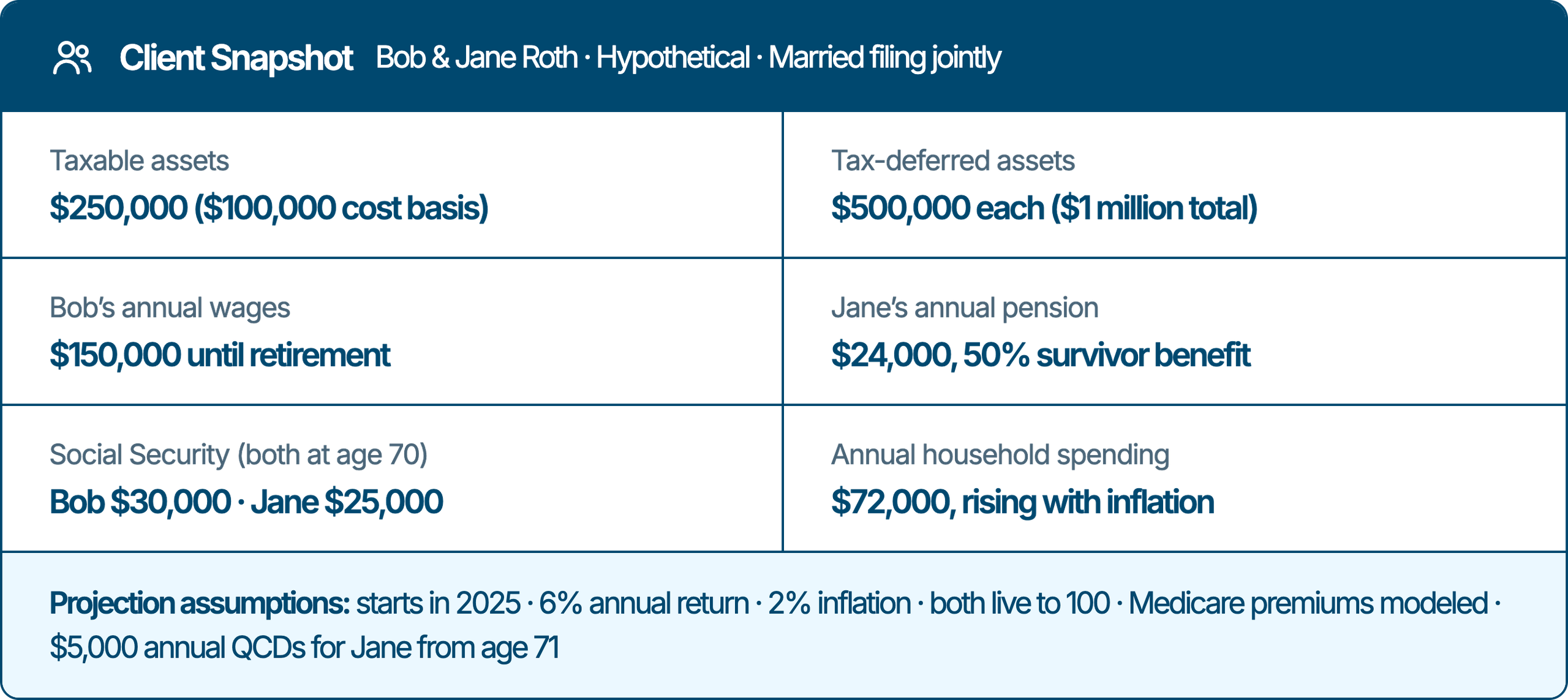
With these assumptions entered, the Roth Projection Tool provides a visualization of the couple’s projected income and taxes over time.
Identify the Roth Conversion Sweet Spot
Here’s where the planning opportunity becomes apparent.
Bob’s income drops significantly when he retires at 64. However, the couple won’t begin collecting Social Security until later, and their RMDs are still years away. That creates a window in which their taxable income is relatively low.
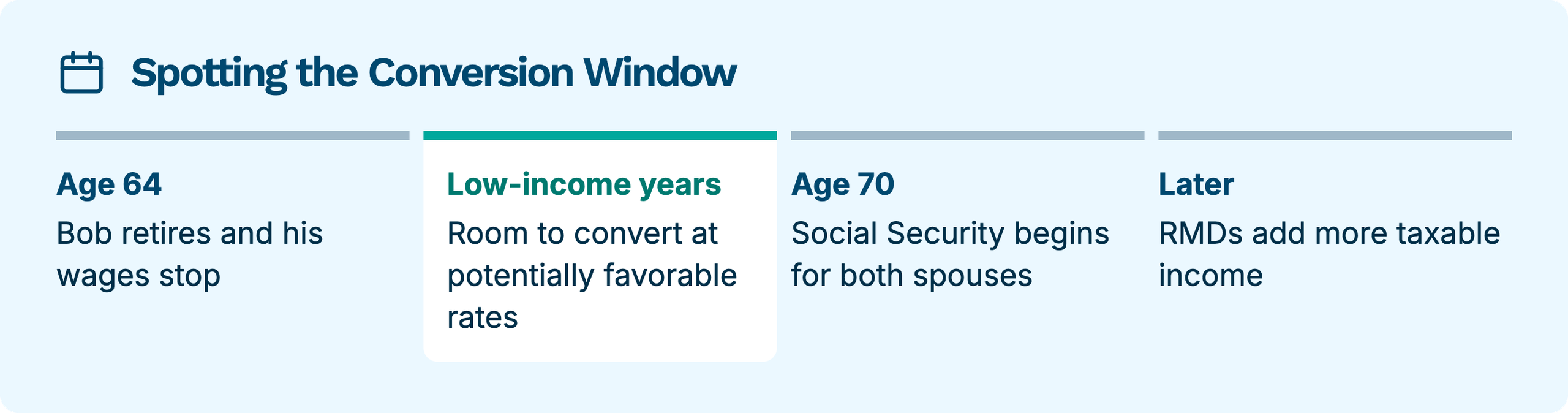
Without proactive planning, Bob and Jane could miss the opportunity to convert tax-deferred retirement assets at potentially favorable tax rates. Meanwhile, their traditional retirement accounts could continue growing, eventually producing larger RMDs and potentially higher taxes.
The Roth Projection Tool makes this income gap easy to visualize.
Instead of guessing whether Roth conversions make sense, the advisor can identify years when conversions might be particularly beneficial.
Model Conversions Across Multiple Years
In this example, the advisor uses the tool to build a series of conversions for Bob and Jane, targeting available room within the 12% federal income tax bracket under the assumptions used in the demonstration.
Bob’s conversions begin when he retires, initially at approximately $90,000 annually. As other income sources enter the picture, his conversion amounts decrease.
Jane’s conversions begin later, initially at $30,000 annually. They’re subsequently adjusted upward and then downward as Social Security and RMDs affect the couple’s taxable income.
The important takeaway here isn’t any single conversion amount. It’s that the strategy changes over time as the couple’s circumstances change. The Roth Projection Tool lets advisors adjust conversion amounts, evaluate the tax implications, and compare projected outcomes against a baseline in which no additional conversions occur.
RELATED: See this use case in a video demonstration
See the Potential Lifetime Impact
In the demonstration, the modeled multi-year strategy produces some striking results:
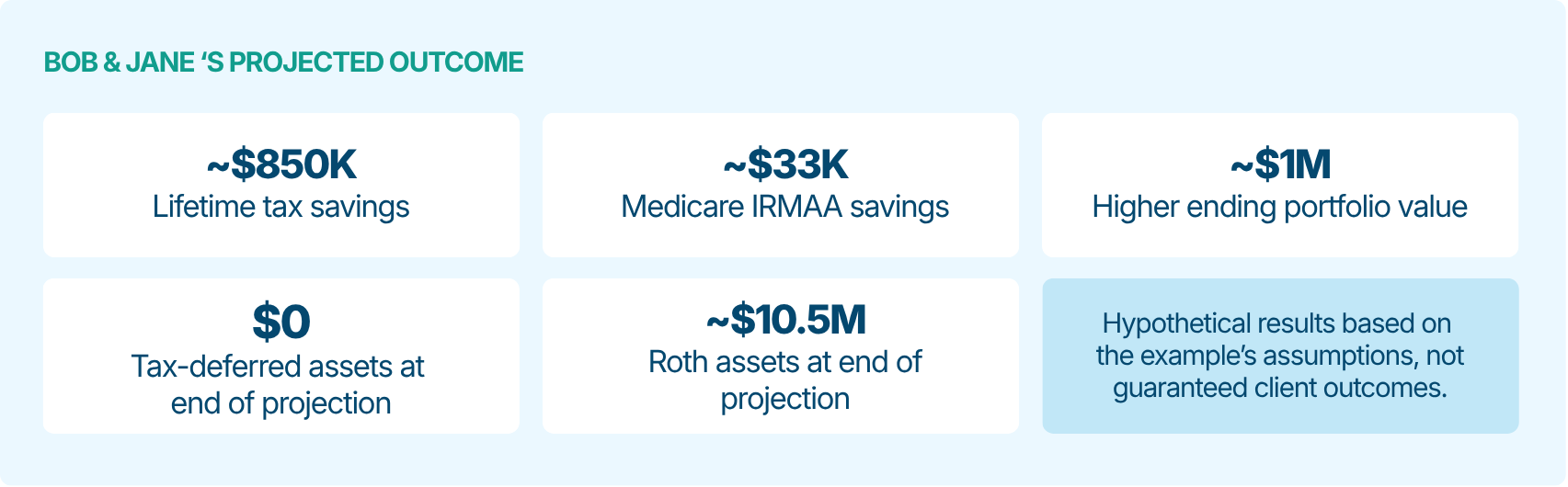
These are hypothetical results based on the example’s assumptions, not guaranteed client outcomes. Still, they demonstrate why focusing exclusively on a client’s current-year tax bill can be shortsighted.
By paying some taxes earlier through strategically timed Roth conversions, Bob and Jane may substantially reduce their projected lifetime tax burden.
✍️ The advisor takeaway: Roth conversion planning shouldn’t stop at identifying an opportunity in one tax year. The real value comes from developing a coordinated, multi-year strategy that accounts for changing income, RMDs, Medicare premiums, and long-term wealth accumulation.
USE CASE #2
Show Clients the Long-Term Value of Roth Conversions
Even when a Roth conversion strategy makes financial sense, communicating its value to clients can be challenging. After all, you’re asking clients to voluntarily increase their taxable income today in exchange for potential benefits they may not realize for years or decades.
Holistiplan’s Roth Projection Tool helps advisors turn that abstract conversation into something much more tangible.
Move Beyond the Current Year’s Tax Bill
Returning to Bob and Jane, consider what happens if the couple doesn’t make additional Roth conversions.
During the years immediately following Bob’s retirement, their income decreases, creating relatively low-tax years. But their tax-deferred retirement accounts continue accumulating value.
Eventually, Social Security benefits and RMDs add to their taxable income, potentially pushing them into higher tax brackets and increasing their Medicare premiums. With the Roth Projection Tool, advisors can show this progression visually.
The tool allows advisors to compare the baseline scenario with the Roth conversion scenario, displaying how their projected tax liabilities differ over time. Clients can see how paying more taxes during lower-income years could help avoid significantly higher taxes later.
That’s a much more compelling conversation than simply telling a client that Roth conversions might save them money.
Make the Analysis More Comprehensive
One distinguishing feature of the Roth Projection Tool is that it evaluates more than federal income taxes.
For example, the tool incorporates household spending needs into the projection. That matters because a client’s income and expenses determine whether money needs to be withdrawn from investment accounts to support their lifestyle.
If retirement income doesn’t cover annual spending, the tool models withdrawals from the portfolio. It also considers how taxable-account cost basis and investment growth affect the potential tax consequences of those withdrawals.
Advisors can also model Medicare assumptions, including the possibility of IRMAA surcharges resulting from higher income. The tool includes controls for changing projection assumptions, viewing results by calendar year or age, and comparing nominal dollars with today’s dollars, too.
This broader perspective helps advisors evaluate Roth conversions as part of a comprehensive retirement strategy rather than treating them as isolated tax transactions.
RELATED: See this use case in a video demonstration
Demonstrate the Impact on Wealth Transfer
The Roth Projection Tool can also be particularly valuable when working with clients who want to leave assets to their heirs.
In Bob and Jane’s baseline scenario, the projection shows approximately $1 million in remaining tax-deferred assets at the end of the plan. For many non-spouse beneficiaries, inherited traditional retirement accounts must be fully distributed by the end of the tenth year following the original owner’s death, subject to applicable exceptions and distribution rules.
Those distributions can create substantial taxable income for beneficiaries, particularly if they’re already in their peak earning years.
Now compare that with the Roth conversion scenario. By the end of the projection, Bob and Jane have approximately $10.5 million in Roth assets and no remaining tax-deferred assets.
That creates a potentially more favorable inheritance picture.
Qualified distributions from inherited Roth accounts are generally tax-free, although many beneficiaries must still empty those accounts within ten years. This means heirs may receive assets with more favorable income tax treatment and, depending on applicable rules, the opportunity for continued tax-free growth.
Turn Projections Into Better Client Conversations
Rather than discussing Roth conversions solely in terms of marginal tax brackets, advisors can use the Roth Projection Tool to answer questions clients actually care about, like:

The tool’s graphical comparisons help make those tradeoffs easier to understand. And because advisors can adjust assumptions and show or hide different elements of the projection, they can focus the conversation on each client’s priorities.
✍️ The advisor takeaway: The Roth Projection Tool doesn’t just help identify tax planning opportunities. It helps advisors explain why those opportunities matter, demonstrate potential outcomes, and make complex planning strategies more accessible to clients.
USE CASE #3
Compare Roth Conversion Tax Brackets to Find a More Effective Strategy
Once an advisor identifies an opportunity for Roth conversions, another question arises: How do you determine which tax bracket to target?
Should you convert just enough to fill the 22% bracket? Would filling the 24% bracket produce better long-term results? Could converting into an even higher bracket ultimately reduce lifetime taxes?
Historically, evaluating these possibilities could require substantial manual modeling.
Holistiplan’s Roth Projection Tool offers a faster approach through its Compare All Brackets functionality.
Run Multiple Strategies in Parallel
In this third use case, the advisor starts with a baseline projection that includes several lower-income years.
Rather than manually testing one conversion amount after another, the advisor selects a range of years and uses the Compare All Brackets feature to evaluate multiple strategies simultaneously.
For example, the demonstration compares conversions from 2025 through 2035. The tool runs projections targeting different federal income tax brackets and displays the outcomes side by side.
Advisors can also consider Medicare IRMAA thresholds when evaluating conversion strategies. This makes it possible to explore how different conversion targets affect projected lifetime taxes and financial outcomes without individually constructing every scenario.
Identify the Most Favorable Outcome
In the demonstration, filling the 24% tax bracket produces the strongest projected outcome based on the portfolio value metric being evaluated.
Compared with the baseline scenario, that strategy produces:
- Approximately $664,000 in additional ending portfolio value, after adjusting tax-deferred assets for an assumed 24% future tax liability
- Approximately $1.5 million in projected lifetime tax savings
- A favorable result even when comparing ending portfolio values before the tax-deferred asset adjustment
Interestingly, the 24% bracket doesn’t produce the greatest possible lifetime tax savings. Filling the 32% bracket generates slightly more tax savings in this example.
That’s an important distinction. The strategy that minimizes lifetime taxes isn’t necessarily the strategy that maximizes projected ending wealth.
An advisor might reasonably prioritize portfolio value, lifetime tax savings, Medicare costs, or another objective depending on the client’s circumstances.
The Compare All Brackets feature helps make those tradeoffs visible.
RELATED: See Holistiplan’s Compare All Brackets feature in action
Apply the Selected Strategy
Once the advisor identifies a preferred conversion target, the tool can automatically calculate the conversion amounts needed to fill the selected bracket during the designated years. It then incorporates those conversions into the full projection, allowing the advisor to review the resulting long-term outcomes.
What previously might have involved repeated calculations and manual adjustments becomes a streamlined process for comparing possibilities. The result isn’t just greater efficiency. It’s the ability to evaluate a wider range of strategies before recommending a course of action.
✍️ The advisor takeaway: Instead of assuming that staying in the lowest possible tax bracket is always best, advisors can compare multiple conversion targets and identify the strategy that most closely aligns with a client’s long-term financial goals.
Turn Roth Conversion Opportunities Into Action With Holistiplan
Successful Roth conversion planning requires more than identifying unused space in a tax bracket. It requires understanding how today’s decisions could affect tomorrow’s taxes, retirement income, Medicare costs, portfolio value, and inheritance.
And it requires being able to communicate those implications clearly enough that clients can make informed decisions.
That’s where Holistiplan’s Roth Projection Tool delivers.
As these three use cases demonstrate, advisors can use the tool to build multi-year Roth conversion strategies, illustrate their potential lifetime impact, and compare different conversion targets to identify more favorable outcomes. Instead of relying on one-year calculations or manually building multiple scenarios, advisors can evaluate the bigger picture and translate complex tax planning decisions into meaningful client conversations.
That means more informed planning, clearer recommendations, and a stronger opportunity to demonstrate the value of ongoing financial advice.
With Holistiplan’s Roth Projection Tool, you can identify strategic conversion windows, quantify potential lifetime tax savings, compare multiple strategies, and help clients understand how today’s decisions could shape their financial future.
Stop guessing how much your clients should convert. Start modeling what could work best. Discover how Holistiplan’s Roth Projection Tool can transform your tax planning process.