If you own an accounting, bookkeeping, tax, or CFO firm and constantly feel busy but not adequately paid, the problem may not be the amount of work coming through the door. It might be the way you’re positioning, pricing, and selling that work.
That’s an especially common challenge when firms expand beyond compliance into higher-value advisory services. You may know exactly how to uncover a planning opportunity, solve a tax problem, clean up a financial process, or help a business owner make smarter decisions. But knowing how to charge appropriately for that expertise, and confidently communicate why it’s worth the investment, is a different skill.
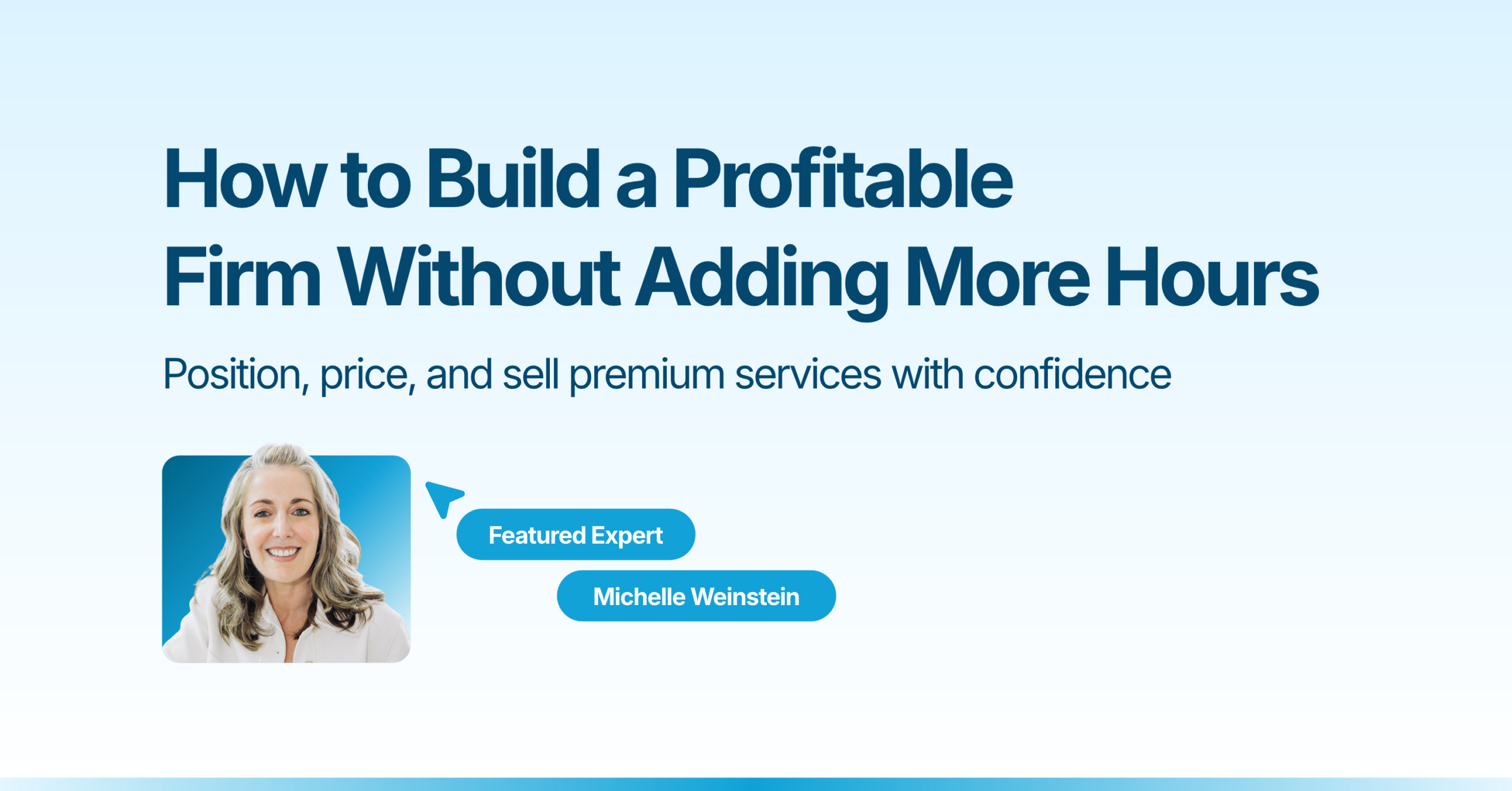
Michelle Weinstein, founder of The Abundant Accountant, works with accounting, tax, bookkeeping, and CFO firm owners on exactly that challenge: building profitable firms without simply adding more hours, more clients, and more work. Her framework comes down to five fundamental steps.
Step 1: Check Your Sales Beliefs
Before you change your pricing, packages, or sales process, examine what you actually believe about selling.
Many tax professionals entered the profession because they like solving problems, not because they wanted to become salespeople. As a result, phrases like “selling,” “premium pricing,” and “closing a client” can feel uncomfortable. You might worry that charging more is greedy, that clients only care about price, or that proactively recommending an additional service will make you seem pushy.
Those beliefs matter because they affect how you communicate. If you don’t believe your advisory service deserves a premium price, your prospect is likely to sense that uncertainty.
“Selling is a skill and an attitude that anyone can learn,” Weinstein said. “It is a skill set just like you can learn how to do a tax plan, just like you can learn how to do a tax return. It’s a step-by-step structured process.”
A better way to think about selling is as helping a client recognize a problem and giving them the opportunity to solve it. If you know a client could reduce unnecessary taxes, strengthen cash flow, improve their financial reporting, or avoid an expensive mistake, bringing that issue to their attention isn’t an imposition. It’s part of being proactive.
The goal isn’t to become a high-pressure salesperson. It’s to become comfortable explaining the value of the problems you already know how to solve.
Step 2: Know Your Value—and Price the Outcome
One of the quickest ways to remain overworked and underpaid is to price sophisticated advisory work based primarily on the hours required to complete it.
Your clients aren’t really purchasing hours. They’re purchasing an outcome.
That distinction becomes particularly important as your firm becomes more efficient. If experience and technology allow you to identify an opportunity in 30 minutes instead of three hours, that doesn’t make the insight any less valuable. In fact, it often makes your expertise more valuable.
“People pay for the results you deliver,” Weinstein said. “It’s all about the result. They really don’t care how you got there.”
Start taking inventory of what your firm brings to the table: credentials, years of experience, specialized industry knowledge, continuing education, technology investments, and, most importantly, the results you’ve generated for clients. That could include taxes saved, financial problems avoided, additional cash flow uncovered, more informed business decisions, or simply the peace of mind that comes from knowing someone is looking ahead rather than recording history after the fact.
Your fee should reflect the significance of the problem you solve and the value of the outcome, not simply how long it takes you to produce a deliverable.
Step 3: Choose Your Clients Wisely
If your firm is already at capacity, accepting every prospect who calls isn’t necessarily growth. It might just be adding more work.
Premium advisory services require a different approach. Instead of asking, “Can we do this work?” ask, “Is this the kind of client our firm is best equipped to help?”
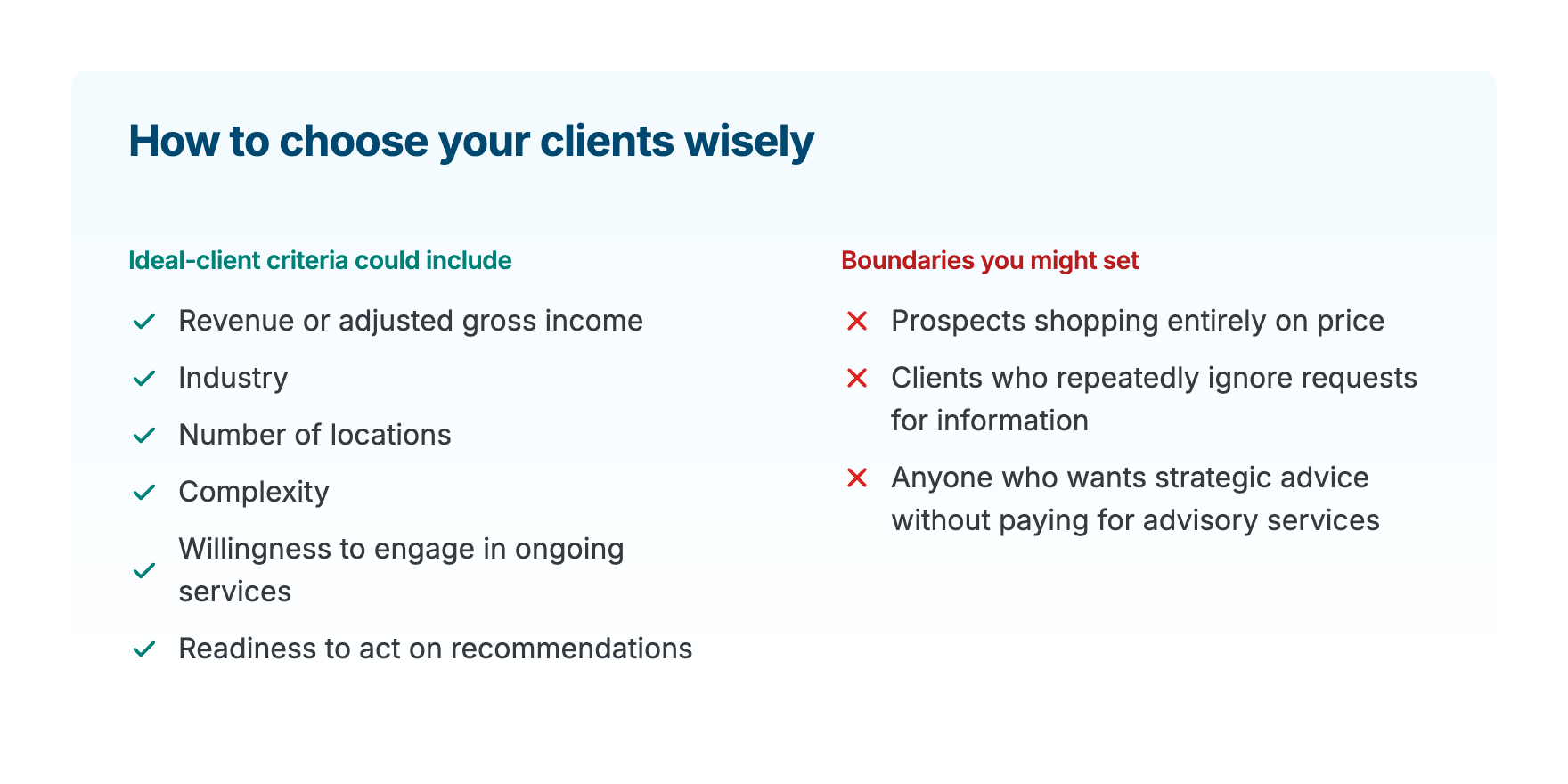
“You get to choose,” Weinstein said. “But this is really important because the more picky you get, the more money you will make and the more people you can help and serve.”
Narrowing your focus can feel risky, especially when you’ve spent years believing every new client equals new revenue. But the wrong clients consume capacity that could otherwise go toward clients who value your expertise, follow your process, and are willing to pay for meaningful outcomes.
Step 4: Build a Repeatable Sales System
When every prospective-client conversation is improvised, it’s difficult to sell consistently, and even harder to delegate or scale. A repeatable sales system removes much of that uncertainty.
“Implementing a sales system allows you to engage your ideal clients and charge fees that you never thought were possible to charge,” Weinstein said. “And having a sales process allows you to get paid upfront. It gives you confidence and it shows that you’re providing the clients results that they cannot get from anyone else.”
Preparation starts before the meeting. Gather the information you need—tax returns, financial statements, accounting data, and other relevant documents—so you can diagnose the client’s situation beforehand. Then prepare strategic, open-ended questions. During the conversation, let the client do much of the talking. Present your findings at a high level and connect them directly to the client’s problems and desired outcomes rather than burying the conversation in technical details.
At the end of the meeting, make a clear offer and be prepared to move forward. That includes knowing the scope, price, engagement terms, and payment expectations before the meeting.
The objective is to replace the passive cycle of sending a proposal and waiting with a structured process you can repeat.
Step 5: Invest in Mentoring and Skill Development
Technical expertise alone doesn’t automatically translate into confident pricing or better sales conversations.
Like tax planning, bookkeeping, accounting, or CFO work, communicating value is a skill. And skills improve faster when you get feedback.
“The last step is investing in mentoring,” Weinstein said. “Because as simple as this is, there are a million ways to mess it up.
“I always say, ‘Why try to figure it out on your own when someone like me can just hand you the answers?’”
Mentoring and skill development could mean working with a coach, practicing sales conversations, role-playing difficult pricing discussions, reviewing calls, or learning from firm owners who’ve already built the type of advisory practice you want.
The human side of advisory still matters. Clients need someone who can ask the right questions, listen, simplify complex information, and confidently recommend a path forward.

Put the Five Steps Into Practice With Holistiplan
Confidence becomes much easier when you have a repeatable way to uncover, analyze, and communicate valuable planning opportunities.
That’s where Holistiplan can help turn these five steps into a scalable advisory workflow.
Holistiplan helps tax and financial professionals expand proactive tax planning without sacrificing depth or accuracy. Its reports and scenario-analysis capabilities can also help professionals work more efficiently and clearly communicate planning recommendations after a client engages.
That supports Weinstein’s framework in several ways. Holistiplan can help you:
- Identify meaningful planning opportunities that reinforce the value of your expertise
- Evaluate which clients have needs that warrant deeper advisory conversations
- Create a more repeatable process for analyzing client situations
- Produce reports and scenarios that make the outcomes of your recommendations easier to understand
By the way, becoming more efficient doesn’t mean you should automatically charge less. Weinstein specifically notes that using Holistiplan to complete work faster shouldn’t translate to discounting your expertise. The focus should remain on the outcome you deliver.
Holistiplan won’t replace the confidence, communication skills, boundaries, or mentoring required to build a premium advisory practice. What it can do is give your firm a powerful technical foundation for delivering that advisory service consistently and at scale.
If you’re ready to stop giving valuable planning insights away for free, create a more repeatable advisory process, and show clients the value your firm can deliver, book a Holistiplan demo today.
✅ See how Holistiplan can help you turn your expertise into a scalable, higher-value service and build a firm that rewards you for the value you provide.