📌 Free Download: Don’t let year-end planning slip through the cracks. Download the CPA’s Q4 2026 Tax Planning Checklist and standardize your client workflow from review to execution
The fourth quarter is more than the final stretch of the calendar year for CPAs. It’s one of the best opportunities to move clients from tax compliance to proactive tax planning.
By Q4, much of a client’s financial picture has come into focus. Business owners have a clearer idea of annual profits. Employees know whether bonuses or equity compensation are likely to hit before year-end. Investors can see realized gains and losses. Retirees have a better handle on distributions and required minimum distributions. At the same time, there’s still enough runway to make meaningful changes before December 31.
That distinction matters. Tax preparation primarily answers, “What happened, and what do I owe?” Tax planning asks a different question: “What can we still do now to improve the outcome?”
For CPA firms looking to deliver more proactive value to clients, Q4 is the time to ask that question. Here’s a practical checklist for the final months of 2026.
1. Start With a Current-Year Tax Projection
Before recommending a Roth conversion, charitable gift, equipment purchase ,or other strategy, establish an accurate 2026 baseline.
Update the client’s projected wages, business income, investment income, capital gains, retirement distributions, deductions, credits, withholding, and estimated tax payments. Pay particular attention to anything that has changed materially since the prior-year return.
For 2026, the standard deduction is $32,200 for married couples filing jointly, $16,100 for single taxpayers and married taxpayers filing separately, and $24,150 for heads of household. The individual marginal tax-rate structure continues to range from 10% to 37%.
But a projection should do more than calculate an expected balance due. It should become the starting point for testing alternatives.
What happens if the client recognizes another $30,000 of income? Contributes more to a retirement account? Harvests a capital loss? Makes a charitable gift? Buys equipment for the business?
That comparison between the baseline and the alternative is where proactive tax planning begins.
2. Flag High-Earning Clients Who Need Attention
High earners frequently present some of the most actionable Q4 planning opportunities.
Start with clients who have had large balances due or unusually large refunds in previous years. Both can indicate that withholding and estimated payments deserve another look. Then identify clients with sizable investment gains, equity compensation, bonuses, or other income that might not be fully reflected in their withholding.
Retirement and HSA contributions also deserve attention.
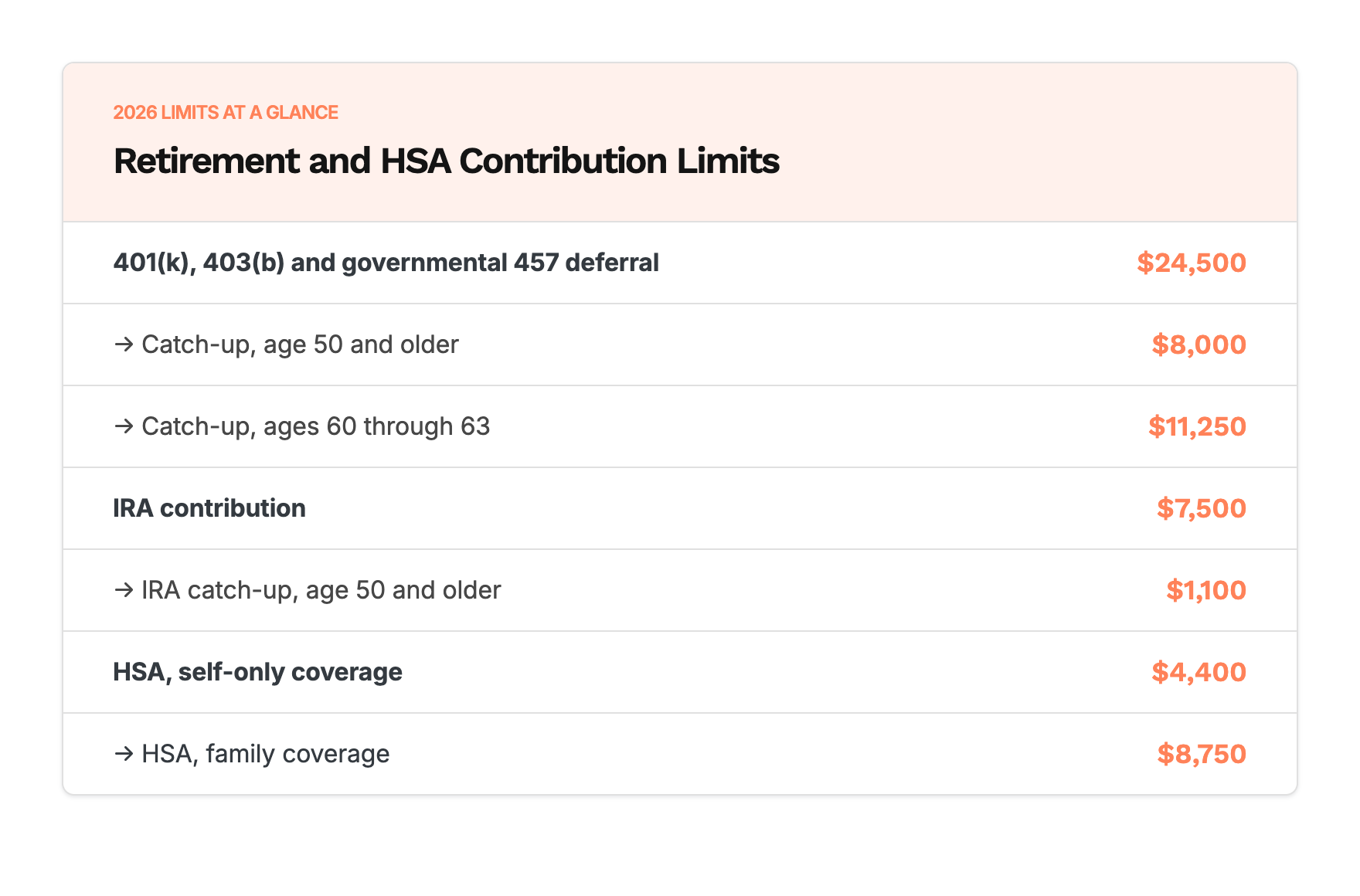
For CPAs, the planning question isn’t simply whether a client can make another contribution. It’s how that contribution interacts with taxable income, deductions, credits, and the rest of the client’s tax picture.
3. Revisit Itemized Deductions and Charitable Giving
The deduction landscape deserves special attention this year.
The federal state and local tax deduction limit is $40,400, or $20,200 for married taxpayers filing separately for 2026. The limit begins to decrease at higher modified adjusted gross income levels, although it generally cannot be reduced below the familiar $10,000 floor, or $5,000 for married filing separately.
That makes Q4 a good time to revisit state income taxes, property taxes and, where relevant, state-level pass-through entity tax strategies.
Charitable planning has also changed. Beginning with tax year 2026, qualifying taxpayers who don’t itemize may deduct up to $1,000 of certain cash charitable contributions, or $2,000 for married couples filing jointly.
For clients making larger gifts, look beyond simply asking whether they plan to donate before year-end. Consider the timing of contributions, appreciated assets, donor-advised funds and qualified charitable distributions where applicable.
🥇 The goal is to coordinate charitable intent with the client’s broader tax picture, not treat giving as an isolated deduction.
4. Review Capital Gains, Losses, and Investment Income
Investment activity can quickly change a year-end tax projection.
Request updated information on realized capital gains and losses, expected mutual fund distributions, and any significant transactions that may still occur before December 31. Then check the prior-year return for capital loss carryforwards.
Tax-loss harvesting may be useful for some clients, but the decision shouldn’t stop at comparing gains with losses. Additional investment income can affect adjusted gross income, the net investment income tax, and other income-sensitive calculations.
Instead of just asking, “Can we offset this gain?” run the transaction through the entire projected return. It’s especially important for high earners whose investment activity can create ripple effects well beyond the capital gains tax itself.
5. Give Business Owners a Separate Q4 Review
Business owners often require an entirely different planning conversation.
Review projected profits, estimated tax payments, owner compensation, retirement contributions, and major expenditures. Clients with multiple entities, K-1 income, 1099 income, rental property, or passive activities may require additional modeling.
Entity structure should also remain on the radar. For example, a growing sole proprietorship or LLC may warrant a conversation about whether another tax structure might make sense. The answer depends heavily on the client’s circumstances, reasonable compensation requirements, and broader business goals, so it should be modeled rather than assumed.
Capital expenditures deserve particular attention in 2026. Current law provides a 100% additional first-year depreciation deduction for many categories of qualifying property acquired and placed in service after Jan. 19, 2025. The maximum Section 179 deduction for tax years beginning in 2026 is $2.56 million, subject to applicable limits and phaseouts.
The qualified business income deduction is also permanent under current law. For 2026, the Section 199A threshold is $403,500 for married couples filing jointly and $201,750 for most other filers, with phase-in ranges above those amounts.
These provisions make projected business income and the timing of business decisions particularly important before year-end.
6. Prioritize Pre-Retirees and Retirees
Clients approaching or already in retirement often have several interconnected Q4 decisions.
Start with required minimum distributions for clients subject to them. Then look at Roth conversion opportunities, qualified charitable distributions, capital gains, and the sequencing of retirement-account withdrawals.
A Roth conversion is a good example of why scenario analysis matters. The question usually isn’t just, “Should this client convert?” but rather, “How much should this client convert, and what else changes if they do?”
The additional taxable income could interact with the client’s marginal bracket, investment income, deductions, and Medicare income-related monthly adjustment amounts. The same principle applies to the order in which a retiree draws from taxable, tax-deferred, and tax-free accounts.
Clients may arrive with several separate questions—about RMDs, Medicare premiums, capital gains, Roth conversions, and charitable giving—but the CPA’s job is to see how those decisions interact.
7. Fix Withholding and Estimated-Tax Problems Before They Become Tax-Season Surprises
One of the easiest ways to demonstrate proactive value is to prevent an unexpected April tax bill.
Compare projected liability against withholding and estimated payments already made. Flag clients with significant income changes, especially business owners, high earners, retirees taking distributions, and taxpayers who recognized large investment gains. Then determine whether additional withholding or estimated payments make sense.
The conversation is bigger than avoiding penalties. Helping a client understand what they’re likely to owe months before tax season gives them time to manage cash flow. It also avoids the unpleasant experience of discovering a large liability while preparing the return.
8. Turn Every Recommendation Into a Specific Action Plan
A tax projection by itself isn’t a tax plan.
Once planning opportunities have been identified, turn them into a prioritized set of actions. Specify what should happen, the estimated tax impact, who needs to take action, and when it needs to be completed.
This is also where scenario modeling can improve the client conversation.
Rather than telling a client to consider a Roth conversion, show what happens with several conversion amounts. Instead of saying an additional retirement contribution could lower taxes, demonstrate the projected difference. Rather than describing an entity change abstractly, compare the tax results under alternative structures.
Clients are far more likely to act when they can see the potential result.
9. Build Q4 Planning Into a Repeatable CPA Workflow
The biggest obstacle to proactive tax planning often isn’t a lack of opportunities. It’s capacity.
Q4 gets busy quickly. If every planning engagement starts from scratch, proactive planning can become difficult to deliver consistently across a large client base.
Create a standardized workflow: identify clients most likely to benefit, collect updated information, prepare the projection, identify planning opportunities, model alternatives, hold the planning meeting, and provide a prioritized action plan.
The same framework can then extend beyond Q4. More complex clients may benefit from midyear reviews, quarterly planning, multi-entity modeling, or transaction-specific analysis. Q4 planning can become the beginning of a year-round advisory relationship rather than another once-a-year rush.
Put the Entire Q4 Checklist Into Action With Holistiplan
The challenge for many CPA firms isn’t recognizing these planning opportunities. It’s finding them quickly enough—and modeling them efficiently enough—to serve more clients before December 31.
That’s where Holistiplan can help.
Holistiplan is designed to extend the traditional CPA workflow beyond return preparation. CPAs can upload a completed tax return and use it to surface planning opportunities, create client-ready tax reports, and build projections. Pay-stub scanning can help populate current-year wages, deductions, and withholding, while eligible tax professionals can also incorporate IRS transcript data into the planning process.
From there, Holistiplan’s Scenario Analysis feature allows CPAs to create a baseline and compare it against alternative strategies. Income, deductions, and credits can be adjusted to model questions involving Roth conversions, capital gains, charitable giving, business income, and other planning decisions.
The software’s Roth Projection Tool takes your modeling beyond a single tax year. Advisors can illustrate how different Roth conversion strategies might affect a client over time, helping them evaluate the potential trade-offs between paying taxes today and leaving more assets in tax-deferred accounts for the future.
That means Holistiplan can help CPAs work through every stage of the Q4 checklist: identifying clients who may have an opportunity, building projections, spotting issues in a return, modeling alternative strategies, and translating complex tax calculations into something clients can understand.
The technology doesn’t replace the CPA’s judgment. It gives CPAs a more efficient way to apply that judgment at scale, making firms more efficient and helping them deliver more comprehensive planning.
Q4 is the window to move from explaining last year’s tax result to improving this year’s. With Holistiplan, CPA firms can turn the tax data they already have into proactive planning conversations, and give more clients a clear plan of action before December 31.
Make the most of Q4 with Holistiplan.
Book a demo today