A client’s tax return isn’t just a record of what already happened. It can also be one of the most useful tools for identifying future tax planning opportunities.
By the time a 2025 return is complete, you have a detailed picture of the client’s income, deductions, credits, withholding, capital gains, retirement distributions, business activity, and other tax-sensitive financial decisions. That information can help you spot where the client may be headed in 2026, and where proactive planning could improve the outcome before year-end.
That means the 2025 tax return shouldn’t be the end of the conversation. It should be the starting point for 2026.
For CPAs looking to expand beyond tax preparation and provide more year-round advisory services, here are seven areas of the 2025 return that can reveal meaningful planning opportunities for 2026.
1. Review the Client’s Income Mix for 2026 Tax Planning Opportunities
A client’s adjusted gross income matters, but the sources of that income can tell you even more.
Start by reviewing wages, self-employment income, interest, dividends, capital gains, rental income, partnership or S corporation income, retirement distributions, Social Security benefits, and other income reported on the 2025 return. Then ask this important question:
✍️ Which of these income sources will look different in 2026?
For example, a client may have realized a large capital gain in 2025 that won’t recur. A business owner may be expecting significantly higher revenue in 2026. A retiree may begin taking larger IRA distributions or required minimum distributions.
Those changes matter because simply rolling last year’s income forward might not produce an accurate 2026 tax projection. For business-owner clients, consider anticipated changes in:
- Revenue and profitability
- Owner compensation
- Retirement plan contributions
- Equipment or capital expenditures
- Hiring and payroll
- Pass-through income
For retirees, look at expected changes in pension income, Social Security benefits, investment income, IRA withdrawals, and required minimum distributions.
The 2025 tax return gives you the baseline. Your job is to identify what’s changing.
2. Use the 2025 Tax Return to Evaluate 2026 Estimated Taxes and Withholding
One of the most practical uses of a prior-year tax return is evaluating whether a client is paying enough tax during the current year.
The 2025 return gives you important information about prior-year tax liability, adjusted gross income, withholding, and estimated payments. Those figures can help you determine whether the client is on track to satisfy estimated-tax safe-harbor rules in 2026. But safe harbor is only part of the picture.
A client may avoid an underpayment penalty and still face a large, unexpected tax bill. That’s why CPAs should also compare the client’s current-year income and withholding with what happened in 2025.
Ask whether the client has:
- Received a larger bonus
- Changed jobs
- Started or sold a business
- Sold appreciated securities
- Exercised stock options
- Sold real estate
- Increased retirement distributions
- Experienced a major increase in self-employment income
If the answer is yes to any of those, their 2026 estimated tax payments or withholding may need to change.
A midyear or year-end tax projection can help clients avoid one of the most common frustrations in tax planning: finding out in April that they should have acted months earlier.
3. Identify 2026 Tax Bracket Planning Opportunities
The 2025 tax return can also help CPAs understand where a client falls within the federal income tax brackets and whether there may be opportunities to strategically accelerate or defer income.
That matters because effective tax planning isn’t always about reducing taxable income as much as possible. Sometimes the better question is:
💰 When should the client recognize income?
For example, a client who expects unusually low taxable income in 2026 may have an opportunity to:
- Complete a Roth conversion
- Realize capital gains
- Accelerate income
- Exercise certain stock options
- Take additional retirement distributions
On the other hand, a high-income client may benefit from exploring whether certain income can be deferred into a future year.
Because tax brackets, deductions, and other thresholds can change from one year to the next, CPAs shouldn’t assume a client’s 2026 tax situation will mirror 2025. Use the prior-year return as the starting point, then model different 2026 scenarios. This is how tax planning begins to move from historical reporting to forward-looking advice.
4. Review Capital Gains, Capital Losses, and Investment Income
Schedule D and other investment-related sections of the 2025 return can reveal several potential planning opportunities for 2026.
Start with realized gains and losses.
Did the client recognize large capital gains in 2025? Were those gains short-term or long-term? Did the client carry forward capital losses? Was there significant dividend or interest income?
Once you understand what happened, look forward. A client with appreciated investments may benefit from discussing:
- Tax-loss harvesting
- Strategic capital gain realization
- Charitable gifts of appreciated securities
- Portfolio rebalancing
- Capital-loss carryforwards
- The timing of large asset sales
For higher-income clients, investment income could also affect exposure to the net investment income tax and other income-based thresholds. This is one reason tax planning decisions shouldn’t be made in isolation.
Selling an investment, completing a Roth conversion, or recognizing business income can change more than one line on the return. The entire tax picture matters.
5. Look for Deduction and Charitable-Giving Opportunities
The 2025 tax return can also show whether a client’s deductions are being used efficiently.
Start by determining whether the client itemized deductions or took the standard deduction. Next, review major deductible expenses, including charitable contributions, mortgage interest, state and local taxes, and qualifying medical expenses.
If a client’s itemized deductions regularly fall near the standard deduction threshold, there may be an opportunity to discuss the timing of deductible expenses.
Charitable giving is a good example. Instead of making roughly the same amount of charitable contributions every year, some clients may benefit from concentrating several years of giving into one tax year.
Other charitable planning strategies might include:
- Donating appreciated securities
- Using a donor-advised fund
- Coordinating charitable gifts with high-income years
- Timing contributions around liquidity events
The key is to look at the 2025 return and ask whether the same approach still makes sense for 2026. Tax deductions shouldn’t simply happen by default. In many cases, timing makes a big difference.
6. Use Retirement Activity to Find 2026 Planning Opportunities
Retirement-related information on the 2025 tax return can open the door to some of the most valuable tax planning conversations a CPA can have.
Review IRA distributions, pension income, Social Security benefits, Roth conversion activity, retirement-plan contributions, and other retirement income. Then consider what may change in 2026.
Questions to ask include:
- Will the client begin or increase required minimum distributions?
- Is the client considering a Roth conversion?
- Has the client recently retired?
- Is taxable income temporarily lower than usual?
- Could a business owner increase retirement-plan contributions?
- Will additional retirement income affect other taxes or income-based thresholds?
Roth conversions demonstrate the significance of scenario analysis. It’s not just a matter of whether a Roth conversion is a good idea. It’s really a matter of how much the client should convert, and what that conversion would do to the rest of the tax return.
A conversion can affect marginal tax rates, taxable income, investment-related taxes, Medicare premiums, deductions, and other thresholds. The 2025 return gives CPAs the information needed to start modeling those interactions.
7. Treat Unexpected 2025 Tax Results as Signals for 2026
One of the simplest ways to uncover tax planning opportunities is to ask the client:
🧐 What surprised you about your 2025 tax return?
Maybe the balance due was much higher than expected. Maybe the client lost a deduction or credit. Maybe investment income increased taxable income more than anticipated. Maybe estimated tax payments didn’t keep up with a growing business.
Whatever the surprise was, it can point directly to an opportunity for better planning in 2026. For example, you may need to:
- Adjust withholding
- Increase estimated tax payments
- Run more frequent tax projections
- Revisit the timing of income or deductions
- Coordinate more closely with the client’s financial advisor
- Model major financial decisions before they happen
This is also where CPAs can demonstrate the value of year-round tax advisory services. Instead of telling clients why something happened after the year is over, you can help them make better decisions while there’s still time to change the result.
How CPAs Can Turn 2025 Tax Returns Into a 2026 Tax Planning Process
The real value of a 2025 tax return isn’t just the information it contains. It’s what you do with that information next.
A strong 2026 tax planning process can start with five simple steps:
- Review the 2025 tax return for major income, deduction, investment, and retirement trends.
- Identify what’s changed—or is likely to change—in 2026.
- Create a current-year baseline projection.
- Model potential tax planning strategies before implementing them.
- Communicate the results to the client in a way that makes the tradeoffs easy to understand.
That process can turn tax preparation into something much more valuable.
Instead of meeting with clients only to explain last year’s numbers, CPAs can help clients understand the tax impact of decisions they’re making right now. And that creates a much stronger foundation for year-round advisory relationships.
Turn the 2025 Tax Return Into a 2026 Tax Planning Roadmap With Holistiplan
The hard part often isn’t knowing which tax planning strategies are out there. It’s finding a way to efficiently identify the right opportunities across an entire client base, model the strategies, and communicate the results without adding hours of manual work to every client engagement.
The hard part often isn’t knowing which tax planning strategies are out there. It’s finding a way to efficiently identify the right opportunities across an entire client base, model the strategies, and communicate the results without adding hours of manual work to every client engagement.
Holistiplan helps by automating much of that. Its software empowers CPAs to turn tax returns into actionable planning insights, making it easier to move from compliance work to proactive tax planning.
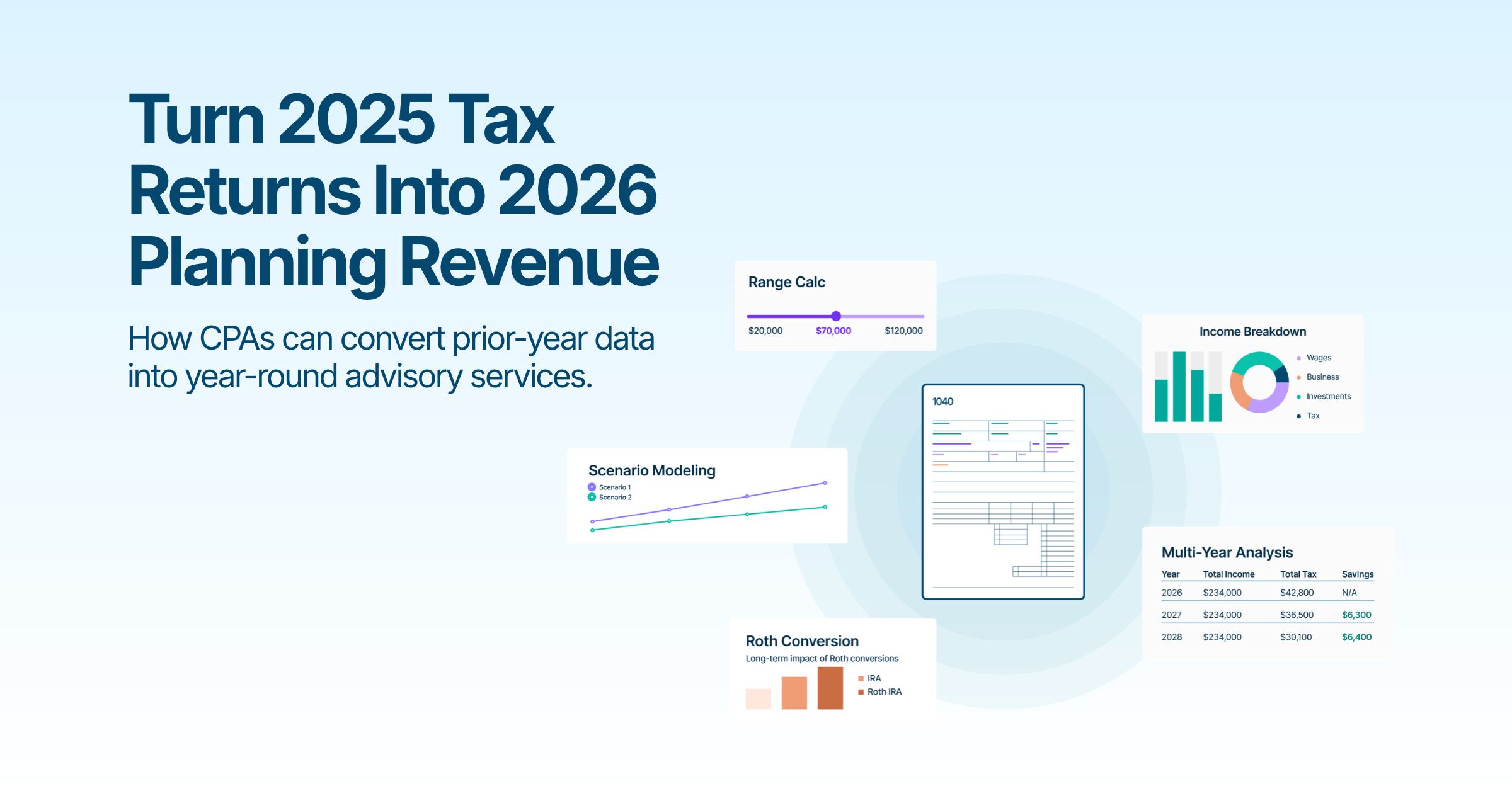
With Holistiplan, CPAs can analyze a client’s tax return, identify potential planning opportunities, and use the Scenario Analysis feature to compare different tax strategies before recommending a course of action. That can include modeling options like:
- Roth conversions
- Capital gains realization
- Charitable giving
- Retirement distributions
- Changes in income
- Changes in deductions and credits
- Other tax-sensitive financial decisions
Instead of manually rebuilding every client’s tax picture from scratch, CPAs can use the prior-year return as a foundation for a more efficient and repeatable planning workflow.
Holistiplan can also help turn complex tax information into client-friendly reports and visualizations, making it easier to explain not just what you’re recommending, but why you’re recommending it. That’s significant, because clients want proactive tax planning that finds opportunities and makes sense to them so that they’re confident to act on them early.
The 2025 return already contains valuable clues about what could matter in 2026. Holistiplan helps CPAs find those clues, model the possibilities, and turn them into meaningful planning conversations.
🏆 Get more value from the tax returns you already prepare. See how Holistiplan can help your firm turn 2025 tax data into proactive 2026 tax planning and build a more scalable, year-round advisory process.
Book a Demo today