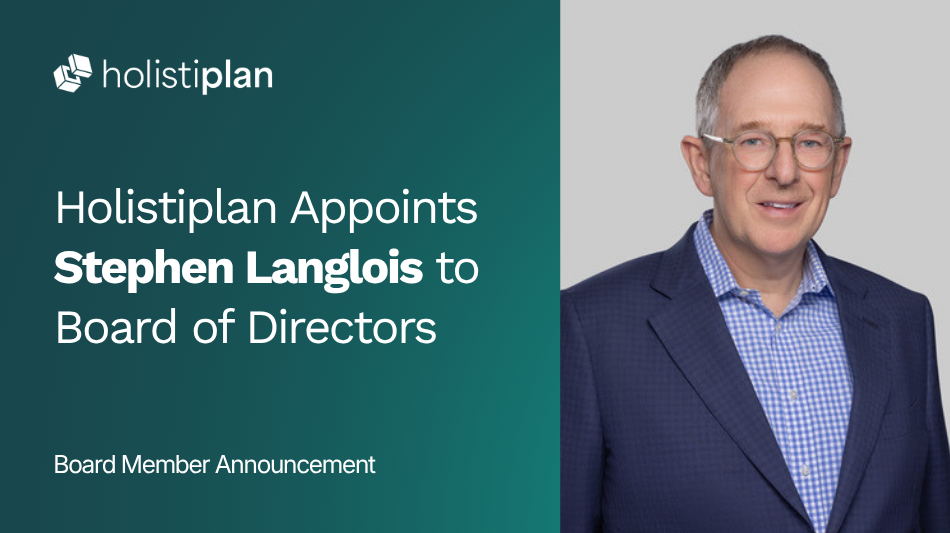
MARCH 26, 2026 – Holistiplan, the leading financial planning software platform used by tens of thousands of advisors nationwide, today announced the appointment of Stephen Langlois to its Board of Directors.
Langlois brings decades of leadership experience across major wealth management firms and innovative fintech companies. He currently serves as Managing Principal of Seaport Consulting Partners and most recently served as President of Kestra Financial, a private equity-backed wealth management platform supporting more than 1,700 independent financial professionals delivering comprehensive financial planning and investment advisory services. Under his leadership, Kestra’s revenue grew 61% over four years and NPS doubled to record levels.
Langlois also spent nine years at Fidelity Investments, where he held senior leadership roles including Head of Distribution Strategy for Fidelity Institutional and Head of Strategic Business Development for Fidelity Wealth Technologies. He led Fidelity’s acquisition of eMoney and later served as Chief Revenue Officer of the company, helping scale the platform across the RIA, broker-dealer, bank, and insurance channels.
“Stephen brings deep operating experience across the wealthtech ecosystem and a strong track record of scaling platforms that empower financial professionals,” said Roger Pine, CEO and Co-Founder of Holistiplan. “As Holistiplan continues to expand its capabilities and reach more advisors, Stephen’s understanding of how enterprise firms, aggregators, and independent advisors evaluate and adopt wealthtech will be invaluable to our board.”
“Tax planning has become a core pillar of financial advice, and Holistiplan has played a significant role in making it easier and more scalable for advisors,” Stephen Langlois said. “I’m excited to work with the team to expand market share and deepen advisor adoption as they continue building tools that help advisors deliver more comprehensive planning and better outcomes for their clients.”
Langlois previously held leadership roles at LPL Financial and Bain & Company and has advised numerous fintech and financial services organizations on strategy and growth. He earned an MBA from the Tuck School of Business at Dartmouth College and a BA from Colby College.
About Holistiplan
Holistiplan is a financial planning software platform designed to help financial advisors and CPAs deliver more comprehensive tax, insurance, and estate planning services. Built by CFP® professionals, Holistiplan synthesizes complex financial data into intuitive insights that improve advisor efficiency and client outcomes. Learn more here.
Q&A with Steven Langlois
You’ve spent much of your career working across the wealthtech ecosystem, from Fidelity to eMoney to Kestra. What initially stood out to you about Holistiplan?
What struck me immediately about Holistiplan was the clarity of the value proposition. Tax planning has historically been one of the most complex, time-consuming, and frankly underserved areas of the advisor-client relationship — and yet it’s one of the highest-value conversations an advisor can have. Holistiplan took something hard and made it elegant and fast. That combination of depth and usability is rare.
From my time at eMoney, I understand what it takes to build a tool that advisors actually want to use in front of clients. The bar is high. Advisors are time-constrained and skeptical of anything that adds friction. Holistiplan clears that bar. It distills complexity into actionable insights in a way that elevates the advisor in the client’s eyes — and that’s exactly the kind of tool that earns a permanent place in a firm’s tech stack.
Tax planning has also moved from the periphery to the center of the comprehensive planning conversation. Increasingly, clients expect their advisor to be proactive about tax strategy, not reactive. Holistiplan is purpose-built for that expectation.
You’ve worked across RIAs, broker-dealers, banks, and insurance channels. How do those multi-channel distribution dynamics shape how successful wealthtech companies grow?
The channels look similar from the outside but operate very differently on the inside. RIAs tend to be early adopters — they make their own technology decisions, move quickly, and will evangelize a great product loudly and proudly. That’s a natural beachhead for any wealthtech company. But it’s a limited addressable market on its own.
To scale meaningfully, you have to navigate the broker-dealer and enterprise channels effectively, and that’s where the dynamics change substantially. In those environments, you’re not selling just to the advisor; you’re also selling to a home office that has to evaluate compliance posture, integration requirements, vendor risk, and cost. The sales cycle is longer, the procurement process is demanding, and the rollout requires training, change management, and executive sponsorship.
What I’ve seen consistently is that SaaS companies that grow well across all channels build a product that’s strong enough to pull through from the bottom up (advisors demanding it) while simultaneously cultivating enterprise relationships at the top. You need both motions working. The organic advisor pull gives you credibility; the enterprise relationship gives you scale.
You’ve had a front-row seat to how large enterprise players evaluate and adopt new technology. What separates the tools that truly gain traction from those that struggle to break through?
Workflow integration and usability. Those two things, more than anything else, determine whether a tool gets embedded into practice or ends up as shelfware.
Advisors run businesses. Their time with clients is sacred. Any tool that requires them to interrupt their flow, export data, re-enter information, or context-switch will struggle for adoption no matter how good the underlying capability is. The tools that win are the ones that slot naturally into what advisors are already doing — they feel less like new software and more like an upgrade to something the advisor already relies on.
ROI clarity matters too, but it’s often misunderstood. The ROI that resonates with advisors isn’t purely financial — it’s about confidence and client experience. A tool that makes an advisor feel more prepared, more authoritative, and more valuable to their client has enormous staying power. That’s what drives word-of-mouth in this industry.
I believe Holistiplan is well-positioned precisely because the product is deep and purpose-built. Large platforms have breadth, but rarely have depth in any one functional area. And AI-native tools, while exciting, still must earn advisor trust which takes time and proof points. A tool with Holistiplan’s track record and category definition has real durability if it continues to execute on product and distribution.
Tax planning has quickly become a core part of financial services. How do you see that trend evolving over the next several years?
Tax alpha is becoming a defining differentiator in the advice business. As investment management has commoditized with fee compression, model portfolios, and passive strategies, the battleground has shifted to planning. And within planning, tax strategy is an area where advisors can demonstrate the concrete, quantifiable value.
I expect that trend to accelerate. The regulatory environment continues to evolve, estate planning considerations remain complex, and clients with concentrated equity positions, business ownership, or retirement transitions have sophisticated tax needs that require proactive guidance. Advisors who can navigate that complexity confidently will win more business and deepen existing relationships.
AI-driven tools will reshape how this work gets done. The ability to model tax scenarios at scale, surface insights proactively, and personalize recommendations for individual client situations will become threshold items rather than a differentiator. What that means for category leaders like Holistiplan is that the obligation to stay ahead of the product curve is real, and the opportunity to define what AI-augmented tax planning looks like for advisors is significant. Companies like Holistiplan, that move thoughtfully but urgently on AI, will extend their lead. Those that wait will find the landscape has shifted around them.
As a board member, where do you think you can add the most value as Holistiplan continues to grow?
Honestly, distribution and go-to-market scaling are where I think I can contribute most. I’ve lived this problem from multiple angles — as a buyer of wealthtech at LPL, Fidelity and Kestra, as a seller and channel builder at eMoney, and as a platform operator who had to weigh competing technology priorities. I understand how decisions get made at the enterprise level, what home offices need to see before they’ll commit, and where the friction points are in advisor adoption.
As Holistiplan expands beyond its RIA base into broker-dealer and enterprise channels, there’s a real opportunity to be thoughtful about how the go-to-market model evolves. That’s not just about adding feet on the street — it’s about positioning, partnerships, pricing, and the narrative you bring to different buyer types. I’ve navigated those questions across enough contexts to offer useful perspective.
I also bring a PE-backed company operating lens that I think is valuable at this stage of Holistiplan’s growth. Scaling while maintaining culture, managing the tension between product investment and commercial urgency, preparing for the next stage of institutional ownership — these are dynamics I’ve lived through, and I’m hoping to help the team navigate them with a bit less trial and error than I had to do myself.